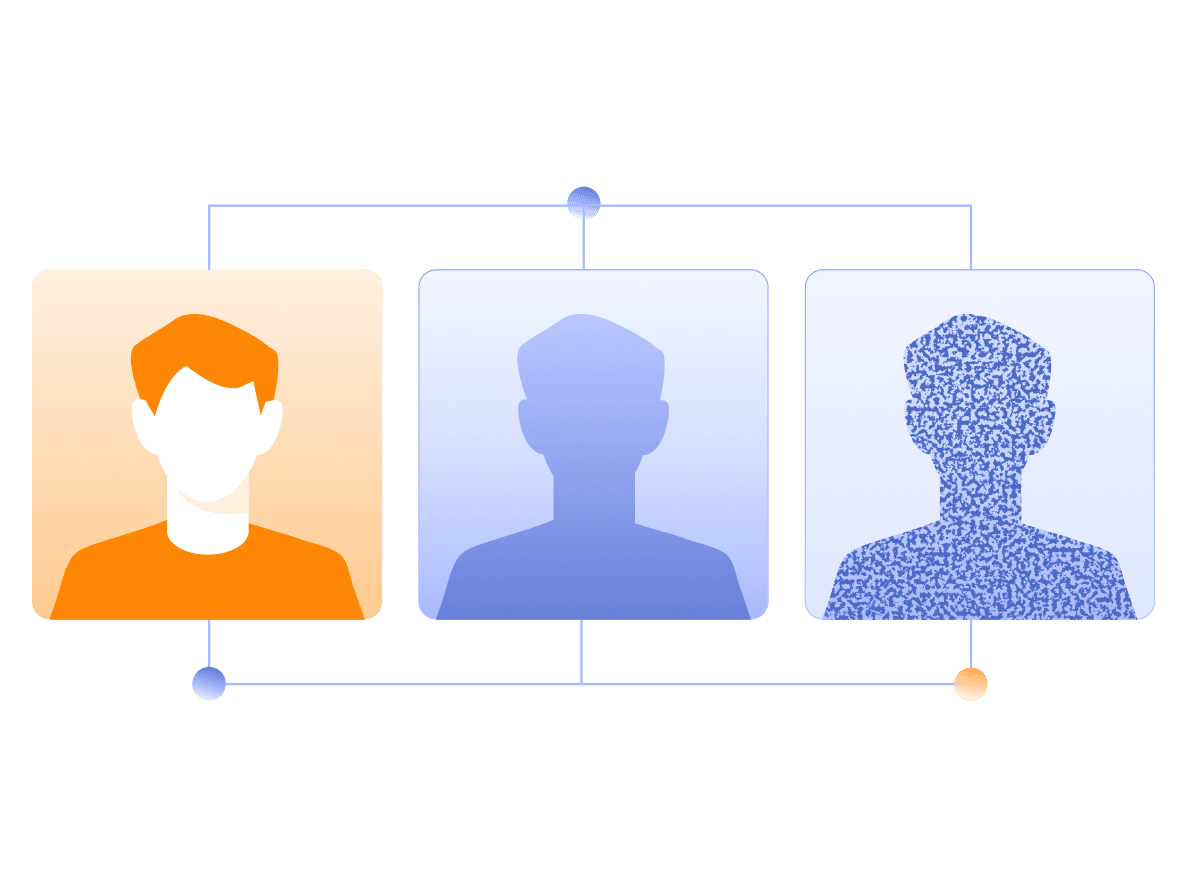
Build generative AI systems producing statistically accurate tabular, image, video, and text datasets for ML model training without exposing sensitive information.
We engineer GAN, VAE, and diffusion model architectures, generating millions of labeled samples meeting GDPR, HIPAA, and CCPA compliance requirements.
Leaders trusting our AI solutions:

90%
Cost reduction generating synthetic datasets vs acquiring and labeling real-world data
6-12 months
Real-world data collection timeline eliminated through synthetic generation
Millions
Labeled training samples generated at fraction of manual annotation costs
Prohibitive $50K-$500K costs for real-world data acquisition and manual labeling
Real-world data collection requires expensive field operations, sensor deployments, participant recruitment, consent management, and quality validation. Manual annotation consumes $0.10-$5.00 per label across millions of samples, with specialized domains like medical imaging or autonomous vehicle scenarios requiring expert annotators charging $50-$100/hour. These costs make large-scale ML model training financially prohibitive, particularly for startups and mid-market organizations.
6-12 month timelines for collecting, cleaning, and preparing training datasets
Real-world data acquisition demands coordinated field deployments, longitudinal data collection spanning months, manual quality validation, consent documentation, and iterative cleaning workflows addressing missing values, outliers, and inconsistencies. Healthcare datasets require IRB approvals adding 3-6 months, while autonomous vehicle data needs diverse weather conditions, geographic locations, and traffic scenarios requiring extended collection campaigns preventing rapid ML development iteration.
Privacy regulations preventing use of real customer data for AI training
GDPR, HIPAA, CCPA, and emerging EU AI Act regulations prohibit using personally identifiable information, protected health information, or financial records for ML training without explicit consent that customers rarely provide. Traditional anonymization techniques (masking, tokenization) destroy statistical relationships essential for model accuracy, while re-identification risks create liability exposure. Organizations cannot leverage valuable proprietary data for competitive ML advantage.
Data scarcity in specialized domains with rare events or edge cases
Healthcare conditions affecting <1% of populations, autonomous vehicle accident scenarios occurring once per million miles, financial fraud patterns representing 0.1% of transactions, and equipment failure modes with years between occurrences create imbalanced datasets where ML models cannot learn rare but critical patterns. Collecting sufficient real-world examples of edge cases requires years of observation making timely model development impossible.
Inherent bias in historical data perpetuating discriminatory outcomes
Real-world datasets encode historical biases: gender imbalances in hiring data, racial disparities in criminal justice records, and socioeconomic inequalities in credit histories that ML models amplify when trained on biased distributions. Removing bias from real data proves technically challenging without destroying predictive signals, while organizations face regulatory scrutiny and reputational damage when biased models produce discriminatory decisions in lending, hiring, or healthcare applications.
Inability to generate controlled scenarios for testing ML robustness
Real-world data lacks systematic coverage of adversarial conditions: autonomous vehicles encountering pedestrians in unusual clothing, facial recognition under extreme lighting variations, NLP models processing deliberately misleading text, or fraud detection facing novel attack patterns. Testing ML robustness requires synthetic adversarial examples, edge cases, and stress scenarios that rarely appear in historical data but represent critical failure modes in production deployment.
Limited data diversity preventing ML generalization across populations
Training datasets concentrate in specific demographics (North American populations, English language, urban environments), device types (high-end smartphones), or operational contexts (ideal weather conditions) creating models that fail when deployed to underrepresented populations, languages, geographies, or operating conditions. Collecting globally diverse real-world data across all demographic segments, languages, and environmental conditions requires prohibitive logistics and budgets.
Difficulty augmenting datasets for class imbalance without statistical distortion
Traditional data augmentation techniques (image rotation, cropping, noise injection) create unrealistic variations that introduce distribution shift, while oversampling minority classes through duplication causes overfitting to specific examples. ML models require statistically faithful augmentation preserving real-world correlations and conditional distributions, which manual augmentation techniques cannot guarantee. This challenge particularly affects imbalanced classification problems in medical diagnosis, fraud detection, and anomaly identification.
What we engineer for AI/ML teams requiring large-scale training datasets

GAN and diffusion model architectures generating millions of labeled samples at 90% cost reduction
We develop generative adversarial networks (GANs), variational autoencoders (VAEs), and diffusion models producing statistically accurate synthetic datasets: tabular data for financial modeling, medical images for diagnostic AI, video sequences for autonomous vehicle training, text corpora for NLP models, eliminating $50K-$500K real-world data acquisition costs and $0.10-$5.00 per-label annotation expenses while generating millions of training samples within weeks.
Automated synthetic data pipelines reducing 6-12 month collection timelines to 2-4 weeks
We build end-to-end generation workflows: data schema definition, generative model training on seed datasets, quality validation testing statistical fidelity, automated labeling with ground truth annotations, and batch export in ML framework formats (TensorFlow, PyTorch), eliminating field deployments, consent management, manual cleaning, and iterative validation cycles that consume months in traditional data collection processes.
Privacy-preserving generation frameworks meeting GDPR, HIPAA, and CCPA compliance requirements
We create synthetic data systems implementing differential privacy guarantees, k-anonymity validation, and re-identification risk assessment ensuring generated datasets contain zero personally identifiable information while preserving statistical relationships essential for ML accuracy. Our frameworks enable organizations to train models on synthetic representations of customer data, medical records, or financial transactions without regulatory violations or consent requirements.
Rare event simulation platforms addressing data scarcity in specialized domains
We engineer targeted generation systems oversampling minority classes—rare disease presentations appearing in <1% of populations, autonomous vehicle accident scenarios, fraud patterns in 0.1% of transactions, equipment failure modes—creating balanced training datasets with sufficient examples of edge cases that require years to collect naturally. Our simulation techniques preserve conditional distributions while amplifying rare events achieving 10:1 or 100:1 synthetic-to-real ratios.

Bias mitigation architectures generating demographically balanced and fairness-aware datasets
We develop fairness-constrained generative models producing datasets with controlled demographic distributions, equal representation across protected attributes (gender, race, age), and bias metrics monitoring disparate impact. Our systems remove historical biases from seed data while maintaining predictive utility, enabling organizations to train ML models that pass algorithmic fairness audits and avoid discriminatory outcomes in lending, hiring, and healthcare decisions.
Adversarial example generators creating stress-test scenarios for ML robustness validation
We build controlled scenario generation systems producing adversarial conditions: pedestrians in unusual attire, extreme lighting variations, deliberately misleading text, novel fraud attack patterns that expose ML model vulnerabilities before production deployment. Our adversarial generation frameworks systematically explore input space regions underrepresented in real data, enabling comprehensive robustness testing across security-critical applications like autonomous vehicles and fraud detection.
Multi-modal generation systems producing globally diverse datasets across demographics and environments
We create synthetic data pipelines generating variations across demographic attributes (age, ethnicity, gender), geographic contexts (urban/rural, climate zones), languages (50+ language support), device types (smartphone models, camera specifications), and operational conditions (weather, lighting, time-of-day), ensuring ML models generalize beyond training distribution homogeneity that causes deployment failures in underrepresented populations and environments.
Statistically faithful augmentation frameworks preserving real-world correlations and distributions
We engineer augmentation systems using conditional GANs and flow-based models maintaining joint probability distributions, feature correlations, and causal relationships from seed data while generating synthetic variants for class balancing. Our frameworks implement statistical fidelity testing (mutual information preservation, correlation matrix validation) ensuring augmented datasets produce ML models with equivalent performance to those trained on larger real-world collections.
Transform your enterprise with AI and data engineering—faster efficiency gains and cost savings in just weeks
Challenge briefing
Tech assessment
Discovery phase
Proof of concept
MVP in production

Reduced ML training data costs by 90% generating millions of synthetic samples vs real-world acquisition
Engineered GAN, VAE, and diffusion model architectures for AI/ML teams producing statistically accurate synthetic datasets: medical images for diagnostic models, financial transaction data for fraud detection, video sequences for autonomous vehicle training, eliminating $50K-$500K data collection expenses, $0.10-$5.00 per-label annotation costs, and manual labeling overhead while generating millions of training samples achieving equivalent model performance.
Accelerated dataset preparation from 6-12 months to 2-4 weeks through automated generation pipelines
Built end-to-end synthetic data workflows: generative model training on seed datasets, automated quality validation testing statistical fidelity (KS tests, correlation preservation), batch labeling with ground truth annotations, and export in TensorFlow/PyTorch formats, eliminating field deployments, IRB approval delays, consent management, and iterative cleaning cycles that consume months in traditional data collection.
Implemented privacy-preserving frameworks achieving GDPR, HIPAA, and CCPA compliance for regulated industries
Created synthetic data systems with differential privacy guarantees (ε-differential privacy), k-anonymity validation, and re-identification risk assessment ensuring generated datasets contain zero PII while preserving statistical relationships. Our frameworks enable healthcare organizations, financial institutions, and enterprises to train ML models on synthetic representations of sensitive data without regulatory violations or consent requirements.
Generated balanced datasets with 100:1 synthetic-to-real ratios addressing rare event data scarcity
Developed targeted generation systems oversampling minority classes: rare disease presentations appearing in <1% of populations, autonomous vehicle accident scenarios, fraud patterns in 0.1% of transactions, equipment failure modes, creating training datasets with sufficient examples of edge cases requiring years to collect naturally while preserving conditional distributions and statistical fidelity.
Eliminated historical bias producing demographically balanced datasets passing algorithmic fairness audits
Engineered fairness-constrained generative models producing controlled demographic distributions, equal representation across protected attributes (gender, race, age), and bias metrics monitoring (disparate impact, equalized odds). Our systems remove historical biases from seed data while maintaining predictive utility, enabling ML models that avoid discriminatory outcomes in lending, hiring, and healthcare decisions.
Created adversarial example generators exposing ML vulnerabilities before production deployment
Built controlled scenario generation systems producing adversarial conditions: pedestrians in unusual attire for AV systems, extreme lighting variations for facial recognition, deliberately misleading text for NLP models, novel fraud attack patterns that systematically explore input space regions underrepresented in real data, enabling comprehensive robustness testing across security-critical applications.
Achieved 95%+ statistical fidelity maintaining real-world correlations and probability distributions
Implemented rigorous validation frameworks testing mutual information preservation, correlation matrix fidelity, and causal relationship maintenance between synthetic and real datasets. Our quality assurance ensures generated data produces ML models with equivalent or superior performance to real-world trained models while eliminating privacy risks and acquisition costs.
Scaled generation systems producing 50M+ synthetic samples across tabular, image, video, and text modalities
Deployed production synthetic data platforms generating datasets at scale: 50M tabular records for financial modeling, 10M medical images for diagnostic AI, 1M video sequences for autonomous vehicle training, 100M text samples for NLP, using distributed training infrastructure (multi-GPU clusters) and optimized inference pipelines delivering synthetic datasets within weeks for immediate ML development iteration.
Build custom synthetic data generation platforms and reduce ML training costs by 90%
Schedule a technical assessment with our synthetic data engineering team to evaluate your current ML training data requirements, acquisition costs, privacy constraints, and model development timelines.
Xenoss team helped us build a well-balanced tech organization and deliver the MVP within a very short timeline. I particularly appreciate their ability to hire extreme fast and to generate great product ideas and improvements.
Oli Marlow Thomas,
CEO and founder, AdLib
Get a free consultation
What’s your challenge? We are here to help.
Machine Learning and automation