

The major bottleneck preventing effective digital transformation in 2026 is misalignment between operations, processes, policies, IT, and finance. 74% of CEOs admit they don’t see eye to eye with CFOs on the long-term value of digital investments, and 55% of tech executives struggle with clearly articulating the value of investing in AI to stakeholders and investors.
And long-term value is exactly what businesses will need to succeed with digital transformation this year. Most innovations will revolve around AI (generative and agentic), cloud computing optimization, and data governance.
This may seem similar to what’s been relevant for the past few years, but now CIOs and VPs of Digital Transformation feel even more pressure to step beyond experiments and justify each technological decision with clear business value. AI ROI will become the most important factor in whether AI projects succeed or stall, with 54% of executives expecting ROI within six months or less.
John Roese, Chief Technology Officer and Chief AI Officer at Dell Technologies, admits in his interview with Deloitte, the importance of ROI in any technical initiative at their company:
In the front end of our process, we require material ROI signed off by the finance partner and the head of that business unit. That discipline has kept experiments as experiments, and production only happens if there is solid ROI.
In this digital consulting guide, we’ll analyze the modern digital transformation trends, identify why businesses fail with their DT initiatives, and develop a remediation strategy to survive the booming digital market and remain afloat.
The core question we’ll answer is: “How do you stop fearing digital transformation failure and which steps to take to lay the foundation for success from the get-go?” Digital transformation is more than replacing digital technologies or improving existing software (it’s modernization). Digital transformation services are about changing how your business works.
The 2026 digital transformation agenda: Agentic AI, data readiness, and intelligent operations
This year will mark a new era in artificial intelligence and machine learning, as businesses stop chasing the AI bubble and choose well-tested AI solutions, extensively trained on their enterprise and customer data, rather than overhyped one-off experiments that only burn budgets without delivering measurable results.
This shift is reflected in recent executive sentiment. A KPMG study surveying more than 2,500 global executives found that 68% of organizations plan to scale AI use cases in production in 2026, up from just 24% in 2025.
Joe Depa, a Global Chief Innovation Officer at EY, supports this point of view:
Last year felt like testing the waters with pilots and proofs of concept. This year is different. It is about going all in on AI and doing it with speed and responsibility.
We’re also witnessing a shift from generative to agentic AI, with 88% of organizations already investing in building AI agents to improve operational efficiency and automate the most time- and effort-consuming workflows. This, however, doesn’t mean companies are abandoning Gen AI; it’s just that they’re seeing the first benefits from generative AI systems and seeking new opportunities.
But for agentic AI and other AI and automation technology solutions to work, businesses have to consider their all-time favourite asset, data, which won’t lose its relevance, neither in 2026, nor in the years to come.
Data readiness, storage, governance, and management practices will define the ROI speed and long-term value of digital transformation initiatives. Business leaders will increase their technology investments in data infrastructure, with priorities distributed as follows:
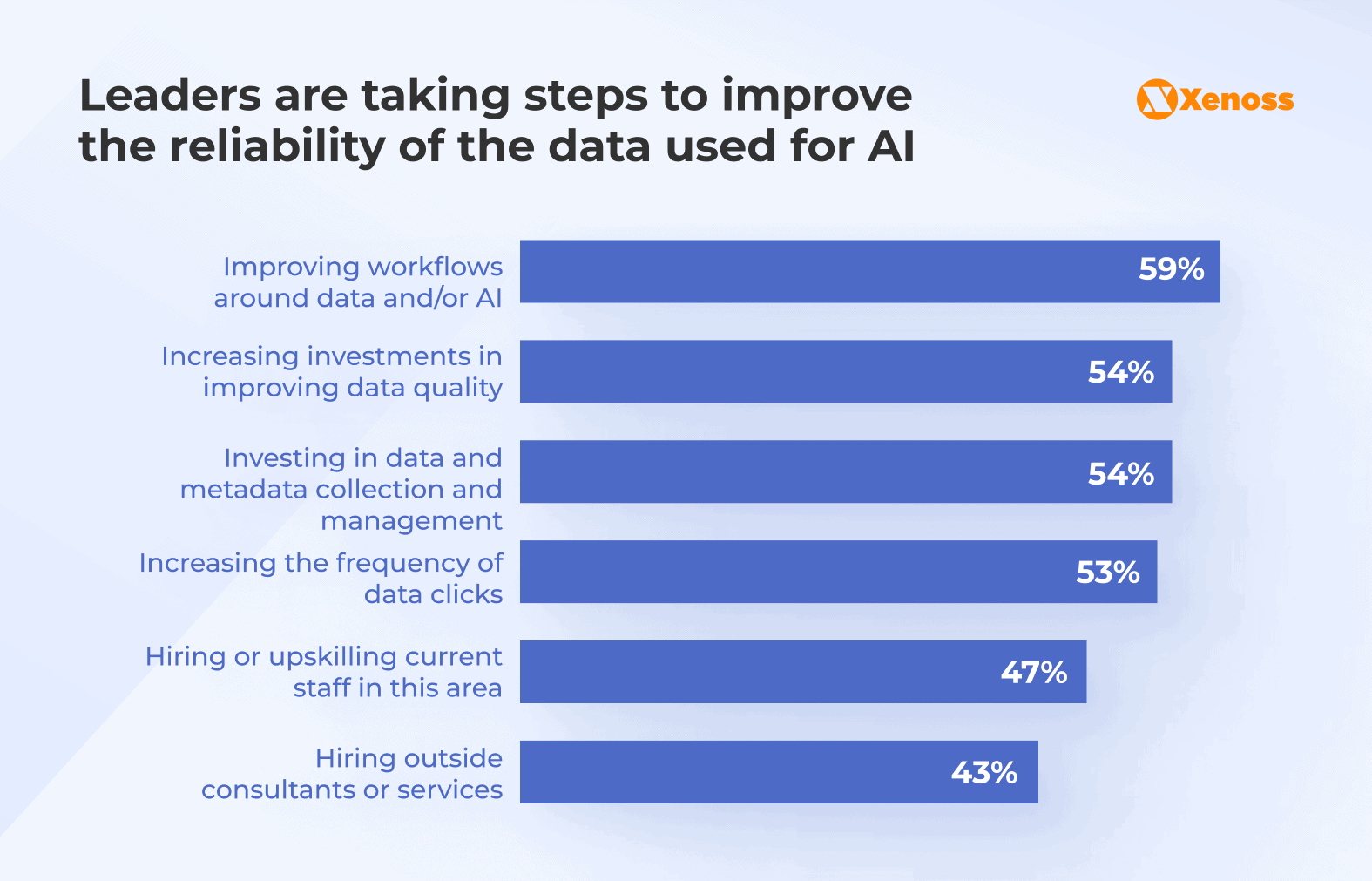
We’ll also see an increase in data lakehouse adoption, enabling businesses to store large volumes of structured and unstructured data while maintaining the performance and ACID compliance of a data warehouse. Data will become the backbone of AI infrastructure reliability, differentiating high-performing digital leaders from laggards.
When AI models, data platforms, legacy systems, and third-party tools collide in production, organizations are tested for resilience, digital maturity, and change capacity. Bottlenecks rarely appear where teams expect them. They surface in legacy integrations, brittle data pipelines, regulatory constraints, and employee resistance to new ways of working.
Therefore, the purpose of a successful digital transformation strategy is to precisely determine the steps needed to embed new technologies into your current operations. That’s why digital transformation consulting services will also focus on organizational changes rather than solely on AI and data engineering.
Why digital transformations fail and how to flip the odds
57% of business leaders say the pace of digital innovation at their companies is slow due to foundational issues in their technology stacks. For 50% of the other survey respondents, it’s data quality. But eventually, each business faces distinct challenges in undertaking a time-consuming endeavor such as digital transformation. Next, we analyze why large organizations fail at their DT programs and define what we can learn from their example.
Starbucks: From digital transformation leader to weak financial growth
The era of AI and automation proved more difficult for Starbucks than expected. Several high-profile initiatives aimed at modernizing store operations, supply chain management, and planning stalled, creating friction instead of efficiency. Automation intended to speed up service and improve availability ended up hurting store execution and customer experience, contributing to uneven performance and slowing growth.
After an unsuccessful launch of the demand planning and forecasting software Siren Systems, Starbucks struggled with inaccurate inventory visibility and unreliable stock replenishment. AI-driven tools failed to account for fragmented supplier data, legacy systems, and the real-world complexity of stores. At the same time, labor reductions made in anticipation of automation gains worsened service quality, forcing leadership to pause, reassess, and partially roll back its automation-first strategy.
Lessons learned: Starbucks’ case shows that digital transformation fails when technology is expected to compensate for weak data foundations, complex operations, and human workflows.
AI and automation deliver value only when they are layered on top of resilient processes, integrated systems, and a change management strategy that treats technology as an enabler.
UK supermarket, Asda, recovers from a failed £1 billion IT overhaul
Asda’s long-planned digital transformation, aimed at replacing Walmart-owned systems with a new independent IT stack, turned into a major operational setback. What was intended to modernize the retailer instead led to shelf shortages, payroll errors, online order failures, lost sales, and customer dissatisfaction, directly impacting day-to-day operations across stores and e-commerce.
During the planning and execution of the migration, costs escalated to £1 billion, far exceeding initial expectations. The scale and complexity of decoupling from Walmart systems exposed deep integration challenges across the supply chain, finance, and people management.
Executive chairman Allan Leighton later pointed to “poor integration, insufficient end-to-end testing, and inadequate capacity planning” as the core reasons the transformation failed. Stabilizing the business and returning to previous sales targets was expected to take around six months, into the second half of 2026.
Lessons learned: Asda’s case shows that large-scale digital transformations fail when core systems are replaced faster than the organization’s operational readiness. Modern digital products cannot compensate for weak integration, limited real-world testing, and governance that allows risk to accumulate unnoticed.
Successful transformation requires phased execution, realistic capacity planning, and the discipline to slow or stop change before disruption reaches customers and frontline employees.
Jaguar Land Rover: Cyberattack halts production and exposes digital risk
In late August 2025, Jaguar Land Rover (JLR) suffered a major cyberattack that forced the company to shut down most of its global IT systems, halting vehicle production at its factories in the UK, Slovakia, Brazil, and India. The company proactively took systems offline to contain the breach, but the impact was severe: production lines stopped, design and engineering software went dark, and tens of thousands of employees were told not to report to work.
JLR’s digital environment had been deeply outsourced and connected, including cybersecurity oversight under an £800m contract with Tata Consultancy Services, aimed at modernizing and managing its IT infrastructure. When hackers breached those systems, JLR had little ability to isolate individual plants or functions, leaving the attack to trigger a near-complete operational standstill.
The disruption rippled through its extensive supply chain of hundreds of component makers, threatening supplier viability and wider economic effects; the incident has been described as one of the most costly cyberattacks in UK history, with estimated economic losses of up to £1.9 billion.
Lessons learned: Jaguar Land Rover’s digital experiences show that highly connected digital ecosystems can become single points of failure when resilience and segmentation are weak. Outsourcing critical functions (especially cybersecurity) without robust oversight, threat modeling, and isolation controls leaves the gains from transformation vulnerable to disruption.
In practice, transformation programs must embed cyber risk as a strategic risk constraint, building strong incident response, segmented architecture, and continuity plans that prevent localized breaches from collapsing entire operational systems.
Selecting a digital transformation consulting partner: Decision framework
A digital transformation consulting partner is a worthy investment if you realize that the consequences of potential risks and issues far outweigh the cost of hiring a digital transformation consultant. But beware of impostors. As, for instance, this Reddit user expresses an opinion on hiring consultants for agentic AI implementation:
The consultant shake-out is real. There’s a huge gap between people who’ve built production agent systems and people who’ve watched demos. That gap is about to become very obvious.
We’ve prepared a comprehensive evaluation framework that can help you choose the best-fit digital transformation consultants.
| Criterion | What to check (reality test) | Why it matters |
|---|---|---|
| Execution track record | Has delivered end-to-end transformations (not only PoCs) in similar complexity and scale | Most DT failures happen during scaling and operations |
| Industry & process fit | Demonstrates deep understanding of your core workflows | Misalignment between software and real operations is a top failure cause |
| Legacy & integration capability | Proven experience in modernizing legacy systems and managing hybrid stacks | Failures often stem from underestimating legacy and integration risk |
| Governance & risk discipline | Clear approach to go/no-go gates, cutover rehearsals, rollback plans | Many failures proceed despite visible red flags due to weak governance |
| Change & adoption ownership | Owns training, enablement, and adoption metrics | Human and adoption failure can stall otherwise sound programs |
| Operating model design | Helps redesign ownership, decision rights, and workflows | DT succeeds or fails in the operating model |
| Outcome accountability | Commits to business KPIs (cost, revenue, reliability, time-to-value) | Roadmaps without measurable outcomes hide failure until it’s too late |
| Partner transparency | Suggests alternative ways when the risk is too high or the sequencing is wrong | Over-accommodating partners amplify risk instead of reducing it |
Your digital strategy consulting partner should be well-versed in your industry to understand the intricacies, regulatory compliance requirements, and overall business specifics. This knowledge will make the team more proactive in suggesting workarounds if your DT strategy needs to change during execution. A proactive digital strategy consultant is more willing to go the extra mile and deliver beyond your expectations.
Building the business case: ROI benchmarks and success metrics in digital transformation strategy consulting
When setting KPIs and success metrics for the digital transformation strategy, it’s important to remember that DT is a long-term undertaking. Often, businesses focus only on short-term goals, but true transformation comes from aligning operational, strategic, and tactical goals.
Leslie Willcocks, professor at the London School of Economics and Political Science and co-author of 75 tech books, names seven capabilities that define digital transformation success:
This [digital leadership] requires being very good at seven core capabilities, namely strategy, integrated planning, embedded culture, program governance, digital platform, change management, and navigation capabilities.
To achieve this seven-fold success, set feasible KPIs on the macro and micro business levels. Below are potential examples:
Macro-level KPIs (strategic impact):
- Revenue growth or margin improvement that can be attributed to digital initiatives
- Time-to-market reduction for new products or services
- Cost-to-serve reduction across core processes
- Percentage of core workflows digitally enabled or automated
- Customer experience metrics (CSAT, NPS, churn) linked to digital changes
- Risk reduction indicators (compliance incidents, downtime, security exposure)
Micro-level KPIs (execution and adoption):
- User adoption rates of new platforms and tools
- Process cycle-time improvements at the operational level
- Data quality and availability metrics (freshness, completeness, accuracy)
- Model or automation reliability (error rates, override frequency)
- Change readiness indicators (training completion, usage depth, feedback loops)
- Delivery health metrics (on-time releases, rollback frequency, defect rates)
The key is not to maximize every metric at once, but to sequence them intentionally. Early digital transformation phases should emphasize adoption, stability, and data readiness; later phases should increasingly weigh revenue impact, scalability, and competitive differentiation.
Technical ROI benchmarks from KPMG vary depending on company size and current team strategy.
| Organization profile | Average ROI | What explains higher returns |
|---|---|---|
| Smaller organizations | 3.6× | Fewer organizational silos, simpler technology ecosystems, lean governance, and faster decision-making enable quicker execution and compounding returns. |
| Early adopters | 2.2× | Earlier experimentation provides more time to learn, refine use cases, and optimize execution compared to late adopters (1.4× ROI). |
| Organizations with fewer cost pressures | 2.6× | Greater flexibility to invest in new technologies allows these companies to pursue higher-impact opportunities without excessive budget constraints. |
| Transformation-focused organizations | 3.2× | Companies allocating ≥50% of tech budgets to transformation benefit from cumulative gains of prior investments, even with lower relative spending in the current year. |
The ROI benchmarks show that digital transformation returns are driven less by how much enterprises spend and more by how effectively they execute. Smaller and early-adopting organizations outperform because they move faster, learn sooner, and operate with fewer integration and governance bottlenecks, while transformation-focused companies benefit from compounding returns over time.
Takeaway: ROI increases when leaders simplify architectures, strengthen data foundations, clarify ownership, and protect transformation investments from short-term cost pressures, treating digital transformation as a long-term operating system change rather than a collection of isolated projects.
Change management: The human dimension of digital transformation
55% of employees report transformation fatigue from the rapid pace and intense pressure of the modern digital transformation programs. Alex Adamopoulos, Chairman and CEO at Emergn, explains this term as follows:
Transformation fatigue isn’t burnout; it’s when teams stop adapting. The best product-led organizations don’t let that happen. They build environments where people can learn fast, adjust, and keep moving. That’s how you win at continuous change.
People are central to a digital transformation strategy. If you’re not considering how they work, what they need, and how to improve their lives, your DT project won’t yield the promised results. Here are a few time-tested recommendations from our digital consulting firm on the change management process:
- Assemble a centralized digital transformation team led by a VP of Digital Transformation. You can also assign a Chief AI Officer who will oversee how AI, data management, and data analytics workloads intersect, affect one another, and impact long-established business processes.
- Develop a blueprint for every system, process, or workflow change, define what will change, who it affects, how it will be rolled out, and what risks it introduces. The goal is to understand the ripple effects in advance and implement changes in a controlled way, with clear success criteria and rollback options.
- Apply project management practices to digital transformation, only on a larger scale. Develop project charts to track key milestones, using a RACI (responsible, accountable, consulted, and informed) matrix to always know which stakeholders to involve in key decisions.
- Conflict management and resolution are another crucial aspect of the change management strategy, as they are bound to arise with large-scale initiatives like DTs. Seek common ground in every situation and treat each employee as an important contributor to the digital transformation’s success.
Final thoughts
Digital transformation isn’t a set-in-stone strategy that should deliver results simply because a company invested a large budget and assembled a huge team of the best software engineers. It’s a subtle, ever-evolving process that should be tailored to each company.
If, for instance, your systems are tightly interconnected so that even a minor disruption can completely stall your business operations, consider this in advance to avoid unpleasant surprises. A digital transformation roadmap should support business models and improve their operations, not disrupt them unnecessarily.
Xenoss brings extensive experience delivering digital transformation strategy consulting across industries and geographies, helping organizations identify risks early and translate them into stronger execution and governance.