

LinkedIn discussions about AI increasingly center on whether generative AI has already peaked and will be overtaken by agentic AI. In the recent Capgemini survey, 93% of organizations believe that companies that successfully scale agentic systems this year will achieve the strongest competitive advantage. Gartner researchers, for instance, also claim that the next digital revolution belongs to agentic AI.
Others remain sceptical, arguing that AI agents haven’t yet achieved the level of promised autonomy, and there is limited evidence of sustained business impact. AI agents still need human intervention to control their actions and verify outputs. 47% of business leaders consider the need for human supervision one of the main drawbacks of implementing AI agents.
At the same time, a growing group of practitioners views generative AI as the most mature, predictable, and operationally reliable form of AI in production. This is clear from the steady growth of GenAI adoption over the past two years, as illustrated below.
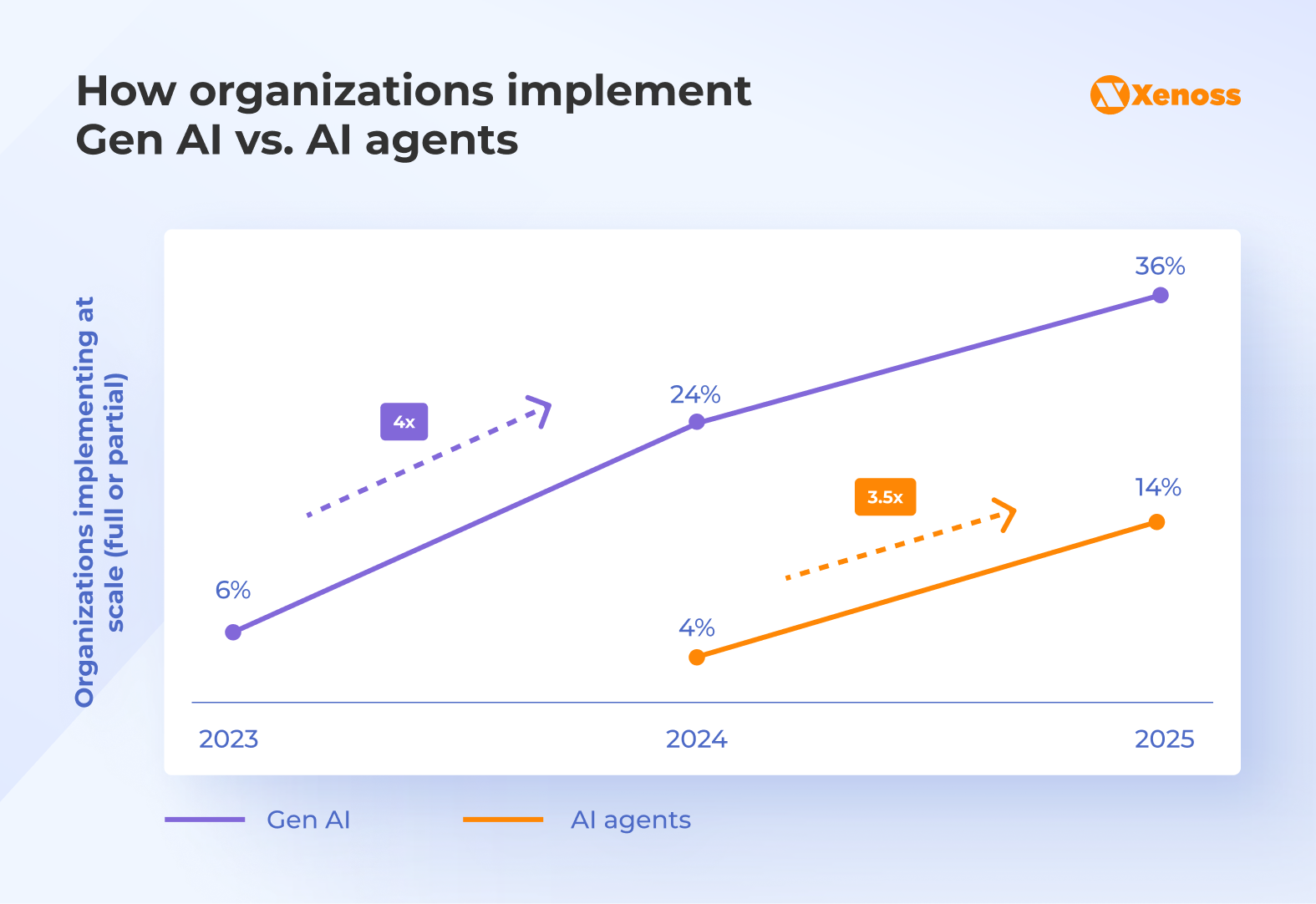
The reality is more nuanced. Both generative and agentic AI are here to stay. Businesses are looking for opportunities to strategically invest in AI and gain the most benefit from it. And whether it will be agentic or generative AI depends on the current problems you plan to solve with it, rather than on which technology is more popular.
This guide breaks down the difference between GenAI and autonomous AI agents to help businesses choose the right tool to meet their current business objectives and make the right strategic moves for the future. We examine both technologies from the perspective of the latest trends, use cases, and industry leaders’ views.
What are generative and agentic AI, and what they’re not
GenAI systems produce text, images, code, video, and audio based on the user’s prompt. Generative AI examples include drafting marketing copy, summarizing legal documents, generating SQL queries, writing support responses, and creating product mockups on demand.
In contrast, AI agents are systems that independently perform tasks on the user’s behalf.
For example, an agent that monitors inventory levels and automatically reorders stock, a pricing agent that adjusts prices based on demand signals, a customer support agent that resolves tickets end-to-end, or an operations agent that detects anomalies and triggers remediation workflows.
This generative AI and agentic definition seems straightforward, but as the AI industry produces new buzzwords almost every day, it’s easy to get confused. For instance, as mentioned in this Reddit post: “Most people use “GenAI” and “LLM” interchangeably, which drives me nuts because it’s like calling all vehicles “cars” when you’re also talking about trucks and motorcycles.”
The fact that GPT, Gemini, and Claude are primarily used to generate text leads people to think that generative AI is only about large language models. But generative AI encompasses much more: latent consistency models (LCMs) for image creation, diffusion models for generating videos, and other architectures designed to produce novel content.
Beyond “smart” chatbots
Another source of confusion is advanced chatbots and virtual assistants. Modern chatbots use generative AI (specifically LLMs) to hold natural, human-like conversations. They can answer questions, summarize information, and draft responses. However, this does not make them “agentic.”
A truly agentic system goes a step further. While a generative chatbot can tell you how to reset your password, an agentic virtual assistant can reset it for you by interacting with the authentication system.
The generative component enhances the user interface and communication, but the agentic component is what provides the autonomous, action-oriented capability. The distinction lies in the ability to execute tasks and change states within external systems.
Let’s see what are AI agents and GenAI assistants are. The comparative table is from the Capgemini report to help you spot the difference.
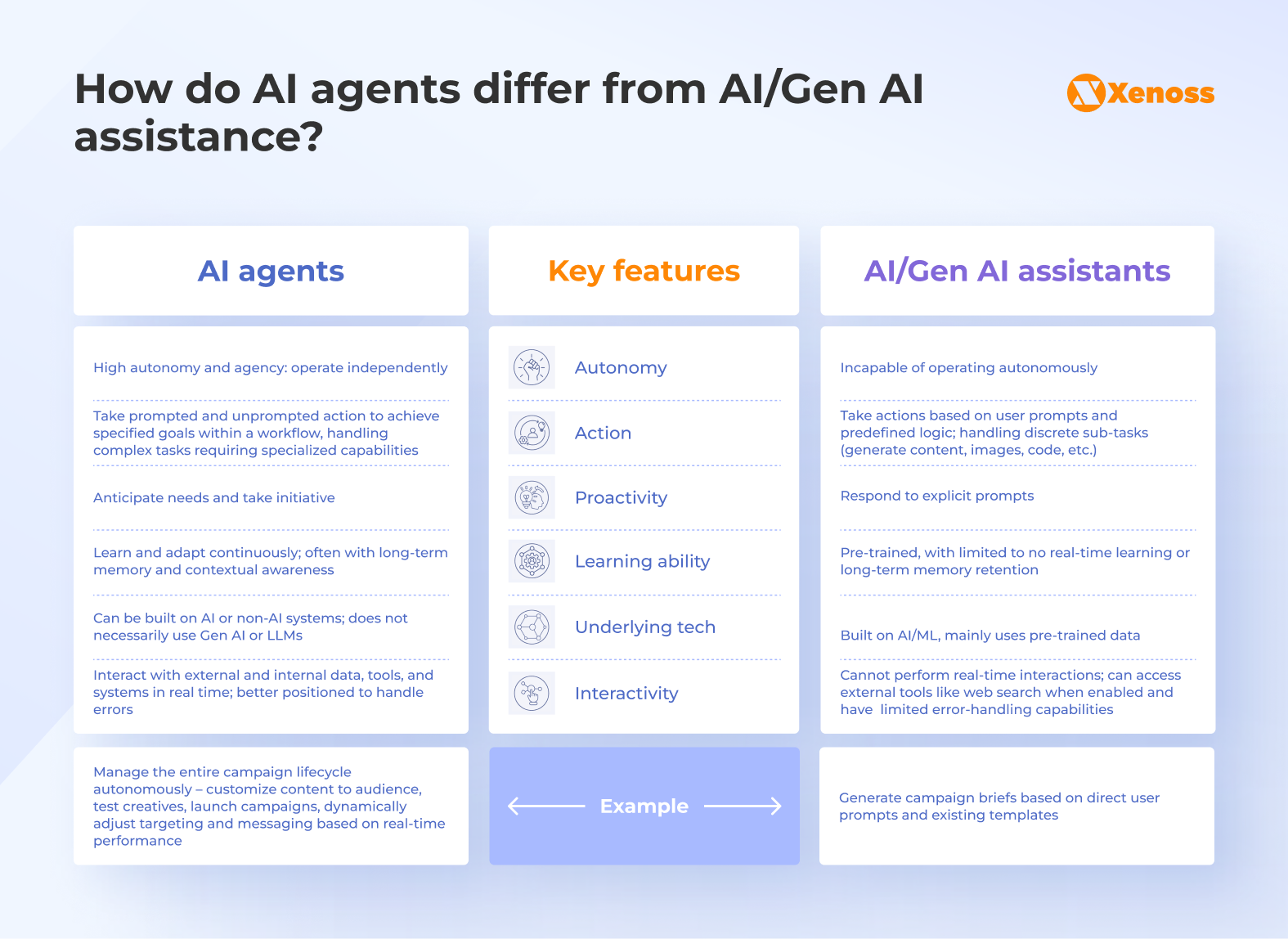
Generative AI systems: Prompt-driven creators and advisors
Generative AI is the most widely deployed AI solution, with 74% of organizations using it in at least one function. It’s based on deep neural networks and advanced machine learning. Unlike traditional machine learning models, which analyze data and make predictions, GenAI can create brand-new content from patterns in training and business data.
Techniques like prompt engineering (including chain-of-thought prompting) and retrieval-augmented generation (RAG) have improved output quality significantly. When combined with proper grounding in business data, modern GenAI solutions deliver accurate results with minimal hallucinations.
One critical consideration: agents inherit the hallucination risks of their underlying LLMs, but the consequences are amplified. A generative AI that hallucinates produces incorrect text. An agent that hallucinates might execute incorrect actions, send erroneous emails, or make unauthorized changes to production systems. This is why governance and operational boundaries are non-negotiable for agentic deployments.
How to benefit from generative AI
The market is moving towards domain-specific and multimodal generative AI systems. Gartner predicts that by 2030, 80% of enterprise software will be multimodal, capable of understanding and acting on text, images, audio, and video in unified workflows.
Success requires focusing on domain-specific customization with an emphasis on processing large amounts of unstructured data. For instance, a global insurance provider can deploy a domain-trained generative AI system to ingest claims documents, accident photos, medical reports, and customer correspondence, automatically extracting relevant facts, summarizing cases, and preparing adjuster-ready recommendations.
Turning fragmented, unstructured information into intelligence, embedded directly in your business workflows, ensures that GenAI systems deliver a consistent, measurable ROI.
Practical applications of generative AI across industries
Generative AI use cases span numerous sectors, accelerating output and reducing manual effort. Here are a few spot-on Gen AI examples
- Marketing and sales. Teams can use GenAI to create hyper-personalized email campaigns, generate A/B testing variations for ad copy, draft social media content, and produce scripts for marketing videos. This accelerates campaign launches and frees marketers to focus on strategy.
- Software development. AI automation tools like GitHub Copilot help developers generate boilerplate code, debug issues, write unit tests, and create documentation. Studies show developers using AI assistants are 55% faster than those who don’t.
- Healthcare. It’s used to summarize patient histories, draft clinical notes for physician review, and create personalized patient education materials. This helps reduce the administrative burden on medical professionals.
- Media and entertainment. Creative professionals use generative AI to storyboard concepts, generate background art for games and films, and compose musical scores, augmenting the creative process.
AI agents: Autonomous executors and problem solvers
An AI agent is an entity that perceives its surroundings, makes decisions, and executes tasks to reach a desired outcome. Among critical generative AI limitations are that these systems respond to a single prompt and stop. Agentic AI receives a goal and pursues it across multiple steps, deciding which actions to take, executing them via external systems, and continuing until the objective is met or escalation is required.
Under the hood, most enterprise AI agents use large language models as their reasoning engine, augmented with the ability to call external tools and APIs.
When an agent “executes a password reset,” it’s: (1) using an LLM to understand the request, (2) selecting the appropriate API from its available tools, (3) making the API call, and (4) interpreting the result. The “intelligence” is the LLM; the “agency” is the orchestration layer that connects reasoning to action.
61% of organizations perceive AI agents as a transformational force, with many companies seeing their first tangible results. Here’s what the Head of AI at the telecommunications company, Cox Communications, Eric Pace, said:
We are beginning to see measurable efficiency gains with AI agents delivering a 30% or more improvement in structured processes.
How to benefit from AI agents
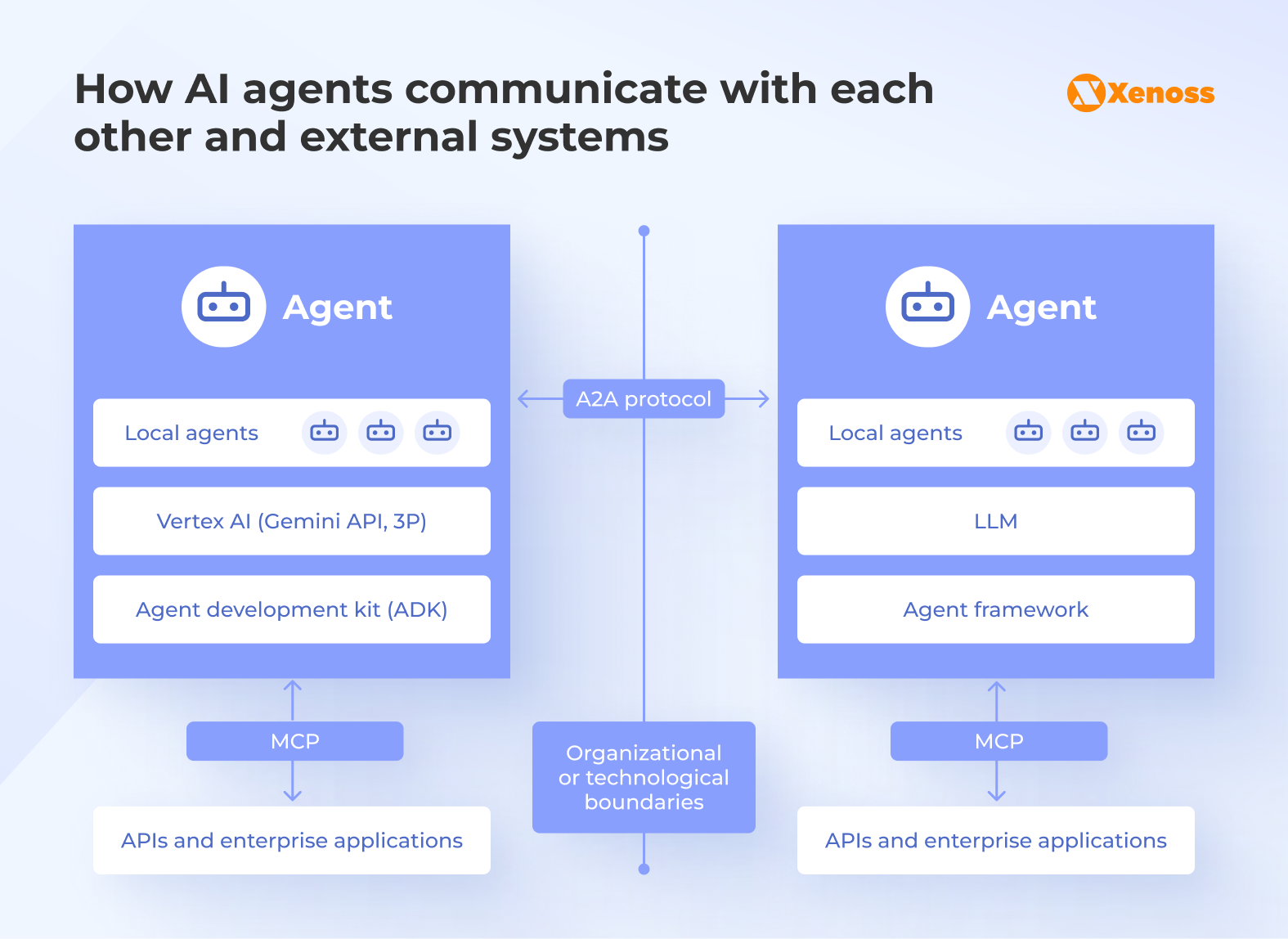
Google’s AI trends report presents the following schema for how AI agents can collaborate to deliver maximum business value. Multi-agent systems require standardized communication. Google’s agent-to-agent (A2A) protocol enables agents to coordinate with each other, while Anthropic’s model context protocol (MCP) standardizes how agents connect to external data sources and tools. These emerging standards matter because they reduce integration complexity: instead of building custom connections between every agent and system, businesses can rely on common interfaces.
In the LinkedIn thread about which AI agentic startups will survive and which won’t, Aryan Lohia and Himanshu Gulati express their opinions on what matters most when developing successful AI agents:
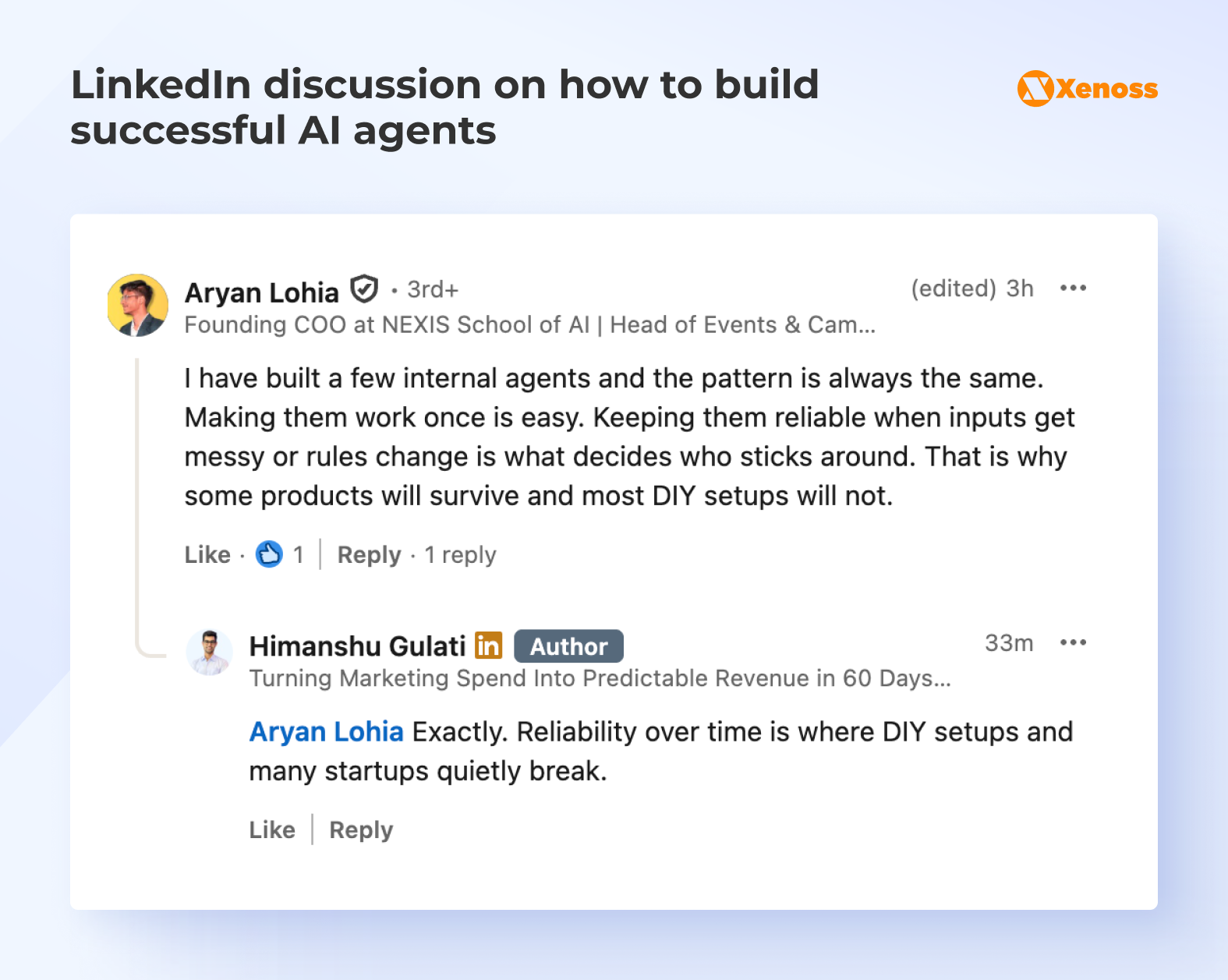
Reliable AI infrastructure is the prerequisite for success in agentic AI implementation.
Practical applications of agentic AI across industries
The impact of agentic AI benefits is clearest in complex operational workflows. In fact, one study found that the average time savings across all tasks was 66.8% when using an AI agent versus manual completion.
- Customer support. An agent can autonomously handle a customer support ticket from start to finish. It can understand the user’s request, query a knowledge base for a solution, execute a password reset via an API, update the ticket in the CRM, and notify the customer of the resolution. Gartner forecasts that agentic AI will autonomously resolve 80% of common customer service issues by 2029.
- IT operations. AI agents can monitor system health, detect anomalies, diagnose root causes, and automatically apply fixes, such as restarting a service or scaling cloud resources, reducing downtime and freeing up engineering resources.
- Finance and accounting. Agents can automate invoice processing, reconcile accounts, and execute trades based on predefined rules and real-time market data, ensuring accuracy and compliance. For instance, BNP Paribas has implemented AI agents to provide proactive investment insights, helping the company enhance customer banking experience.
- Supply chain management. Agentic systems can monitor inventory levels, automatically generate purchase orders when stock is low, track shipments, and proactively manage logistics to avoid disruptions.
Praveen Rao, Director of Manufacturing at Global Strategic Industries, gives real-life agentic AI examples on the manufacturing floor:
[AI-powered] personalization extends beyond consumer experiences. On the manufacturing floor, for example, agentic systems could offer personalized advice to managers. If the second shift underperforms the first, the system could inspect multiple machine criteria and suggest solutions like offering more training or recommending optimal machine set points.
Strategic deployment roadmap: Integrating generative and agentic AI for competitive advantage
Generative AI can serve as the “brain” or reasoning engine for an agent, while the agent provides the “hands” to execute the plan. This creates a feedback loop where content generation informs action, and the results of that action inform the next generation of content.
The collaboration between these two AI types enables robust, hybrid AI systems that can reason, create, and act. Here are a few potential use cases:
- Automated sales outreach. A generative model can draft a highly personalized outreach email based on a prospect’s LinkedIn profile and company news. An agentic system then takes this content, sends the email, schedules follow-ups in the CRM, and analyzes the response. If the prospect replies with interest, the agent can analyze the sentiment and schedule a meeting on a sales representative’s calendar, all without human intervention.
- Intelligent software debugging. When a bug report is filed, an agentic system can first use a generative model to analyze the code and user description to hypothesize a potential cause and suggest a code fix. The agent can then apply this fix in a test environment, run automated tests, and, if successful, push the change to production and update the original ticket.
- Proactive healthcare management. An agentic AI can monitor a patient’s data from wearable devices. If it detects an anomaly (e.g., elevated heart rate), it can use a generative model to draft a clear, concise alert for both the patient and their doctor, summarizing the data and suggesting next steps. The agent then delivers these alerts via the appropriate channels (SMS and the EMR portal).
Designing your AI strategy: Choosing the right tool for the job
An effective generative or agentic AI framework begins with clarity of purpose. Before investing, leaders should ask: “What business problem are we trying to solve?”
- Does the task end with content, or does it require action? Drafting an email → GenAI. Drafting AND sending the email, then scheduling follow-up → Agent.
- Is the workflow predictable or variable? Predictable, rule-based processes may not need agents; traditional automation might suffice. Variable workflows with exceptions → Agents excel.
- What’s the cost of error? High-stakes decisions (financial transactions, medical recommendations) require a human-in-the-loop regardless of AI type. Low-stakes, high-volume tasks are candidates for greater autonomy.
Despite the focus on automation, humans remain a critical part of any AI solution. The “human-in-the-loop” model is essential for governance, oversight, and handling edge cases. For generative AI, this means humans review and edit critical content.
For agentic AI deployment, this means setting the goals, defining the operational boundaries (policies), and intervening when an agent faces a situation it can’t resolve.
The goal of automation is not to replace humans but to augment their capabilities, allowing them to focus on strategic tasks that require judgment and creativity.
Bottom line
Alex Singla, Senior Partner at McKinsey, captures the current state of enterprise AI adoption:
Last year, we noted that generative AI was no longer a novelty and that enterprise adoption was spreading as companies rewired to help realize value. This year’s data confirm that trajectory—AI use is broadening, but scale still lags.
We are seeing that while companies may have rolled out AI tools, most have not yet productized use cases, redesigned workflows around AI and agentic capabilities, or built the platforms/guardrails needed to run them at scale. In working with organizations, we find that the largest ones have the scale to invest in AI to advance more quickly. The companies reporting EBIT impact tend to have progressed further in their scaling journeys.
Technology selection matters, but change management determines whether AI delivers lasting value. Start by evaluating digital maturity to identify where generative or agentic AI can add value. Then focus on building the governance structures, workflows, and organizational support needed to scale.
McKinsey’s research shows that while many companies increasingly adopt AI, far fewer succeed at scaling it. The difference lies in intent: treating AI as a series of experiments versus a long-term capability. One-off projects rarely deliver ROI, while true value emerges as AI solutions when you expand AI use across all business functions. The Xenoss AI and data engineering team helps organizations move from focused AI proofs-of-concept (PoCs) to scalable, production-ready AI systems designed for sustained impact.