

If 2025 taught us anything, it’s that nothing about AI is set in stone. Hardly anyone anticipated the release of DeepSeek and the ripples it sent across the industry.
OpenAI, despite starting the year strong with o3, is now risking losing the LLM market leader title. AI labs shuffled staff, released new models, and made trillions of dollars of investments, hinging on a very uncertain future.
In this post, we are taking a closer look at what that future might look like.
Based on our experience in AI research and development, hundreds of hours in meetings with organization leaders, and our understanding of the market, we defined 10 trends that are set to shape the trajectory of machine learning in 2026.
Enterprise adoption
1. Value of AI generalists in the workplace rises
Why this is likely
- LinkedIn members added 177% more AI literacy skills since 2023, nearly 5x faster than overall skills growth.
- AI adoption is expanding across organizations: over 60% of companies now use AI in multiple functions, with more than half using it in three or more areas.
AI assistants are blurring the boundaries between workplace functions. Teams that once relied on IT for automation tools or dashboards can now build internal platforms with minimal engineering support.
Creative departments that previously coordinated with regional offices for translations can handle localization themselves.
As these capabilities expand, companies will increasingly prioritize generalists who understand how AI systems work and can deploy agents effectively.
“Generalists aren’t unfocused. They’re integrators, they understand context, connect dots, and help teams move faster with fewer people.”
Liam Darmody, Product Manager at With Curious Growth
2. Orchestration will become a bigger focus area than model intelligence
Why this is likely
- 65% of enterprises run 2+ paid models plus at least one open-source model, averaging three models concurrently.
- Operational controls, not model intelligence, are the main bottleneck in workplace AI adoption. Gartner expects 40%+ of agentic AI projects to fail by late 2027 due to cost, value, or risk management issues.
- Early adopters report 20–30% faster workflows with orchestrated multi-agent solutions. In these organizations, insurance claims processing improved by 40% in speed and 15 points in NPS.
Before 2025, the AI community debated whether smarter but slower models were preferable to faster but less capable ones.
Most machine learning engineers favored intelligence, and research followed suit.
Now that state-of-the-art LLMs solve PhD-level math problems and assist world-class programmers, orchestration, not raw capability, has become the bottleneck.
In most organizations, AI tools remain siloed from legacy systems and are poorly integrated.
The focus for 2026 will be on building orchestration layers that unify these tools and combine smaller, energy-efficient models to automate complex, end-to-end workflows, such as invoice processing.
“If you’re following the rise of AI agents, here’s the one idea that separates toy systems from production-grade intelligence. The orchestrator is the real “brain” of a multi-agent system, not the LLM. It decides what to do, when to do it, with which tools, and how each agent’s output flows into the next step.”
Ashish S K, Cloud and AI Architect
3. The Chief AI Officer title will go mainstream
Why this is likely
- Chief AI Officer adoption jumped from 11% (2023) to 26% today, with 66% of CAIOs expecting widespread adoption within two years.
- 33% of organizations now have a CAIO, and 44% believe they should appoint one, indicating rapid formalization of AI leadership.
- Major enterprises like General Motors, UBS, and Expedia Group have appointed CAIOs to drive scaled adoption and unified AI strategies.
Executives are no longer content with AI pilots confined to narrow workflows or single departments.
They want to scale new technologies across the entire organization. Proving this point, in December, Accenture partnered with Anthropic to bring Claude to its 30,000+ employees, and companies across industries are following suit.
The challenge ahead is the absence of a dedicated function to guide implementation, ensure secure rollouts, and build AI literacy organization-wide.
These responsibilities currently fall to CTOs, CIOs, and CFOs, but a new role is emerging: Chief AI Officer.
LinkedIn, General Motors, UBS, and other global organizations have already hired CAIOs to help transition operations from AI-assisted to AI-native.
Their core responsibilities typically include developing company-wide AI adoption strategies, identifying high-yield use cases and evaluating ROI, coordinating the pace of adoption across teams while providing learning resources, and establishing security practices and governance playbooks for deploying AI copilots and agents.
Whether Chief AI Officer becomes a permanent title will depend on how committed organizations are to structured, AI-enabled hyperautomation, and not every company will get the balance right.
At its best, the CAIO connects technology, strategy, and ethics. At its worst… it’s a title created so nobody argues about who’s in charge of the chatbot.
Agus Sudjianto, Senior Advisor, McKinsey & Company
Regardless, by the end of 2026, the market will already have an idea of what makes a successful CAIO, which will make pushing the title into mainstream even easier.
4. Google takes over OpenAI as the LLM market leader
Why this is likely
- 80% of AI developers now consider both Google Gemini and OpenAI GPT/o, with Gemini gaining ground while OpenAI’s consideration remains flat.
- Enterprise market share shifted dramatically: OpenAI fell from 50% to 27% (2023–2025), while Google climbed from 7% to 21%.
- Gemini referral traffic grew 388% year-over-year versus ChatGPT’s 52%, making Gemini a major web entry point for LLM users.
Despite ChatGPT remaining the most popular LLM, Google is starting 2026 strong and growing faster than OpenAI. In 2025, ChatGPT’s monthly active users grew by 6%, while Gemini’s user base increased by 30%.
OpenAI’s latest GPT-5 releases received a tepid reception, while Gemini 3’s widespread praise prompted Sam Altman to declare a “code red” and refocus resources on the next generation of models.

Google also holds a significant advantage over its rivals: distribution. By integrating Gemini directly into Search and Workspace, Google generates millions of interactions per second. As the model gains experience, its reasoning improves—creating a data flywheel that enhances performance without additional training.
With the underlying technology becoming somewhat undifferentiated, an application war is in store. OpenAI has a lead with ChatGPT, which is nearing 900 million weekly users, but Google has a distribution advantage. At this point, it’s anyone’s fight.
Alex Kantrowitz, founder of Big Technology
With all of this compound advantage, Google is poised to become the LLM market leader by 2026.
5. Agentic web takes shape alongside traditional Internet
Why this is likely
- AI platforms drove 1.1B+ referral visits in 2025.
- OpenAI’s Operator demonstrated 87% success on live websites and 58% on complex web tasks, proving agents can handle end-to-end web workflows.
- AI bot traffic to publishers surged from 1 in 200 visits to 1 in 50 by Q2 2025, with 13% bypassing robots.txt restrictions.
2025 was the year of AI agents. OpenAI and Anthropic released Operator and Claude Code early in the year, proving that LLM-powered agents could successfully navigate browsers and system files.
SaaS companies like Salesforce, Atlassian, and Notion followed with agentic assistants, while enterprises built custom agents to automate internal operations.

Yet despite efforts to standardize how agents interact with data sources through protocols like MCP, their capabilities remain limited by a web designed for humans.
A fully functional “internet for agents” is unlikely by year’s end, but tech companies will take steps in that direction, and may even collaborate on a unified navigation layer.
In practice, the emerging agentic web could work like this:
- Humans use AI agents as their gateway to the web rather than switching between sites
- Agents navigate website backends through APIs or communication protocols
- Agents communicate with each other to automate end-to-end tasks like booking flights or grocery shopping.
This agentic web will eventually evolve into a flatter, more decentralized internet, diminishing the dominance of search engines like Google and superplatforms like WeChat.
For companies like digital media, the shift from humans to agents navigating the web will create the need for engaging audiences through other channels, like social media or widely used apps.
My 2026 prediction for digital publishers: The agentic web will require a massive recalibration of audience strategy around the reality that a growing number of visitors are AI agents/bots, not humans.
Jordan Muller, SEO Editor at Politico
6. The regulatory landscape for AI becomes more organized
Why this is likely
- 63% of enterprises now have AI-use policies, with 60% integrating AI risks into enterprise risk management. Among those, 79% monitor AI reliability against legal and policy standards.
- At the board level, 53% are developing responsible-use policies, and 24% each are conducting regular AI audits or implementing formal AI risk frameworks.
In 2025, legal controversies around AI chatbots shifted from IP disputes with musicians and film studios to murkier territory. In early 2026, Google-owned Character.ai settled a lawsuit with the family of a teenager who used the platform to plan his suicide.
No explicit regulation yet establishes liability for LLMs in such tragedies, but as similar cases draw attention, regulators will face pressure to respond.
Defamation is another unresolved area, or as The New York Times puts it, “Who pays when AI is wrong?”
In the article, Reporter Ken Bensinger covered the case of Wolf River Electric, a Minnesota solar contractor that saw contract cancellations spike after Gemini-powered AI Overviews falsely accused the company of settling a lawsuit over deceptive sales practices.
The founders sued Google for defamation to recover financial and reputational damages.
For now, the US is taking a hands-off approach to AI regulation, but as public adoption expands and stakes rise, tighter legal control seems inevitable. The EU has already scheduled detailed guidelines on high-risk AI applications for early 2026.
The European Commission is set to split the AI Act guidelines on high-risk AI systems, according to a presentation shared with member states today. The guidelines on how to classify AI systems remain on track for publication by Feb. 2, 2026. However, the AI Office is now planning a separate set of guidelines covering high-risk obligations, substantial modifications, and the AI value chain, expected in the second or third quarter of 2026.
Luca Bertuzzi, Chief AI Correspondent at MLex
7. The distinction between “traditional SaaS” and “AI products” will blur
Why this is likely
- Budget is shifting toward “AI-native” categories fast. Zylo’s 2025 SaaS Management Index reports AI-native app spending surged 75.2% YoY.
- In MENA, 43 existing tech ventures rebranded as “AI startups,” while only 33 major companies were new AI ventures
To capitalize on the rise of generative AI, leading SaaS startups started embedding GPT-like features and agentic assistants into their offerings. That helped big industry names like HubSpot, Salesforce, or Webflow retain their user base, but the growth of native-AI startups like Lovable and Replit has been a lot steeper.
In 2025, AI-native companies accounted for the majority of all raised funding. Big tech companies are also aiming for an AI-native rebranding – not so long ago, Microsoft permanently changed its name from “Microsoft 365” to Microsoft 365 Copilot.
This year, companies still associated with the traditional SaaS market will have a tough choice to make: should they undergo a full revamp towards an AI-native user experience or risk irrelevance as AI-first teams take over the market?
SaaS and agents merge completely in 2026. Every SaaS product becomes an agent platform, and every agent platform builds SaaS features. The ones that don’t adapt die or get bought for pennies.
Gren Isenberg, CEO of a holding company, Late Checkout
Technical predictions
8. Physical AI will become the buzzword of 2026
Why this is likely
- Amazon deployed its one millionth robot and launched DeepFleet, a genAI model targeting 10% efficiency gains across 300+ facilities.
- Physical AI adoption in manufacturing is set to jump from 9% to 22% within two years, making it a key boardroom theme.
- Figure’s $1B+ raise at $39B valuation shows investors treating humanoid robotics as the next major platform category.
In 2025, LLMs got a reality check, and confidence in scaling laws as the path to AGI began to waver. Now the spotlight is shifting to physical AI as the next frontier.
At CES 2026, AI-powered robots had a commanding presence. NVIDIA unveiled Alpamayo, a family of AI models that will support autonomous vehicle training through real-world data loops and integrated simulation.
Hardware leaders Samsung, Hyundai, and LG presented intelligent robots and home assistants capable of everyday tasks like laundry and meal preparation.
Humanoid robots showed significant progress as well. Boston Dynamics announced that its long-awaited Atlas robot is moving from prototype to product and unveiled an improved design.
Like many humanoids presented at the event, Atlas will have an AI brain. Boston Dynamics is partnering with Hyundai and Google DeepMind to build the model powering it.
With both AI and robotics finally reaching consumer-ready thresholds, physical AI solutions may explode by year’s end. McKinsey estimates the general-purpose robotics market will exceed $370 billion by 2040, and experts expect physical AI to be significantly more impactful than run-of-the-mill LLMs.
Think about all the vehicles and machines you see every day. Now imagine all of them being smarter than ChatGPT. AI has already made a huge impact on our daily lives. But that impact is only going to be magnified as intelligence makes it into the physical world.
Qasar Younis, founder, Applied Intuition
9. AI coding agents will be able to run autonomously for over 20 hours
Why this is likely
- Anthropic’s Claude Sonnet 4.5 can maintain focus for 30+ hours on complex coding tasks, though this isn’t yet a mainstream capability.
- Frontier models now handle tasks with 110-minute completion horizons, with that duration doubling every 7 months since 2019, according to NeurIPS research.
In 2025, large language models made major strides in coding with Anthropic’s Claude Code and OpenAI’s Codex. Yet they remained unreliable over long sessions, accumulating errors faster than a tired human engineer would.
Improving coding agent autonomy is a priority for AI labs—longer unsupervised operation would allow enterprises to automate more complex end-to-end assignments.
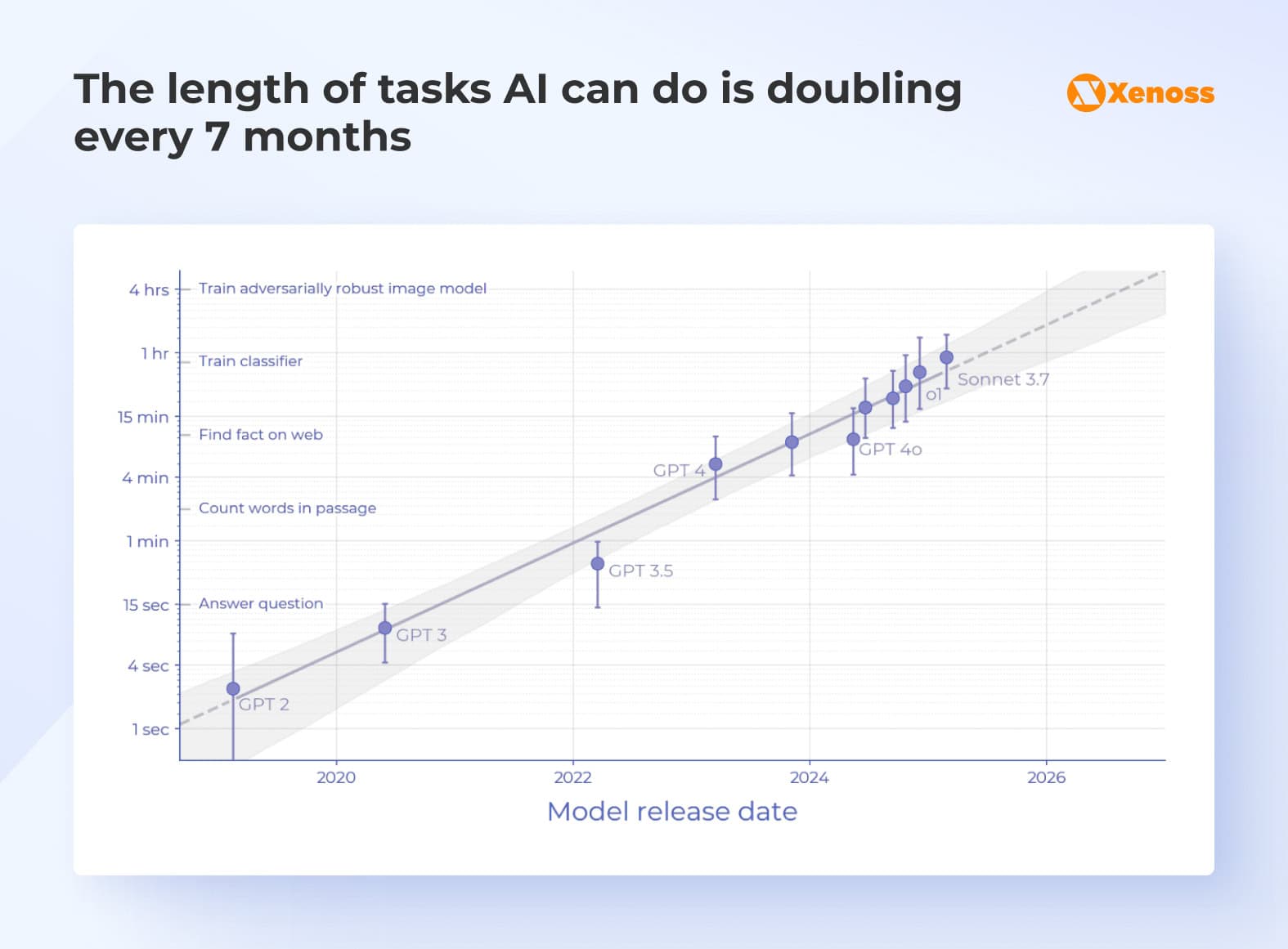
According to METR, a leading AI evaluation lab, the duration coding agents can run autonomously appears to be doubling every seven months.
As of November 2025, Claude 4.5 could work independently for 4.5 hours. If that pace holds, by late 2026, we could see AI engineers completing up to 20 hours of work with minimal human supervision.
10. AI and data stacks merge into a single unified stack
Why this is likely
- Databricks signed a $100 million agreement with OpenAI to natively integrate models into its platform, merging data and AI layers.
- Microsoft Fabric’s unified AI-data platform grew 75% YoY to 19,000+ customers in 2025.
- Snowflake reports 6,100+ accounts using AI tools weekly, driving 50% of new logos and 25% of use cases.
Despite data being the engine of AI projects, data engineering and machine learning stacks have historically developed separately. The “modern data stack” handled ingestion, storage, transformation, and BI, while the “AI stack” focused on deploying models and agentic applications.
That distinction may soon disappear. In 2025, Fivetran and dbt Labs merged into a single toolset for data transformation and AI modeling. Databricks, now valued at over $1 trillion, has successfully championed a unified data, AI, and governance ecosystem.
By year’s end, data and AI engineers expect more mergers and restructuring among data engineering companies, along with vendors adding AI-specific features like agent observability, tagging, and evals to their platforms.
While the ecosystem feels notably more mature, we’re still in the early days of a truly AI-native data architecture. We’re excited by ways AI can continue to transform multiple parts of the data stack, and we’re beginning to see how data and AI infrastructure are becoming inextricably linked.
Jason Cui, partner at Andreessen Horowitz
Bottom line
Mirroring 2025’s dynamic, we expect AI to develop somewhat unevenly in 2026.
Researchers and frontier labs are likely to keep racing towards smarter and cheaper models, though there may be a shift of attention to hardware-based solutions (in fact, most leading AI companies have prototypes in that area).
On the other hand, enterprise organizations will be slower on the uptake and will prioritize proven ROI over technical innovation.
Broader market trends, perhaps, remain the hardest to predict. It’s unclear when or if the AI bubble bursts, how strong public opposition to widespread AI adoption will be, or what impact the opaque AI regulations we currently have will have on vulnerable populations.
To successfully navigate this landscape, leaders should keep a pragmatic approach and commit to transforming their organizations in the highest-yield areas first, then gradually shift from AI-assisted to AI-native organizational makeup. This way, companies will be able to both harness the value of AI technology and stay protected from possible market turbulence.