
Legacy software and application modernization may be frustrating, time-consuming, and, in the worst cases, entirely unproductive. Here’s a cry for help from a developer on Reddit, who wonders what is a realistic timeline for the following modernization project: “Write complete functional documentation for an app you’ve never used, with no subject matter expert, with no one that’s ever seen the codebase, in a language you don’t know, for a type of programming you’ve never done”.
Companies often make the same mistake over and over: placing unrealistic expectations on developers to modernize legacy applications as quickly as possible, without realizing what these projects entail. Instead of investing enough time, effort, and just the right expertise, they waste time and money on modernization that never brings the expected ROI. As a result, they end up in an endless loop of “transformation theatre” where no significant changes occur, but real money is burnt.
In this guide, we will demystify the process of application modernization, translating complex technical concepts into clear business outcomes to help you avoid costly mistakes. We will move beyond the fear of disruption and lay out a strategic framework for achieving a transformation with zero operational downtime, zero business risk, but with tangible business value.
What is application modernization? (and what it isn’t)
At its core, application modernization is the process of updating older software to benefit from modern technologies, architectures, platforms, and engineering practices. But it’s more than simply buying off-the-shelf software. It involves a strategic re-evaluation of your existing applications to align them with current and future business objectives.
A seasoned programmer in the past and now a full-time journalist, Dave McKay compared modernization to changing an aircraft’s propellers to jet engines while the aircraft is airborne. It’s difficult, risky, and sometimes failure seems more probable than success. But with due preparation and a professional team, it’s possible.
In the business setting, application modernization can involve:
- migrating applications to the cloud or hybrid environments
- decomposing monolithic systems into smaller, more manageable services
- rewriting parts of applications to improve performance, security, and maintainability
For example, in healthcare, modernization may mean preserving mission-critical clinical systems while updating scheduling, billing, and data access applications to reduce administrative burden and improve patient experience, without disrupting care delivery.
The goal of every modernization project is to retain the valuable business logic embedded in your legacy systems while eliminating the technical debt and limitations that hold them back.
Here’s what Mayank Madhur, Practice Leader at HFS Research, says on the prospects of legacy modernization:
The legacy application modernization (LAM) market is shifting toward more elastic, scalable, cost-efficient, cloud-native, AI-driven, and microservices-based architectures. Future evolution will be on hybrid environments, automation, and sustainability, realizing legacy value through composable, modular systems for ongoing innovation and shifting digital business needs.
Why delaying modernization is riskier than modernizing
Postponing application modernization often feels like a safer choice. In reality, this inaction accumulates a hidden tax on your business, creating risks that far outweigh the perceived challenges of an upgrade.
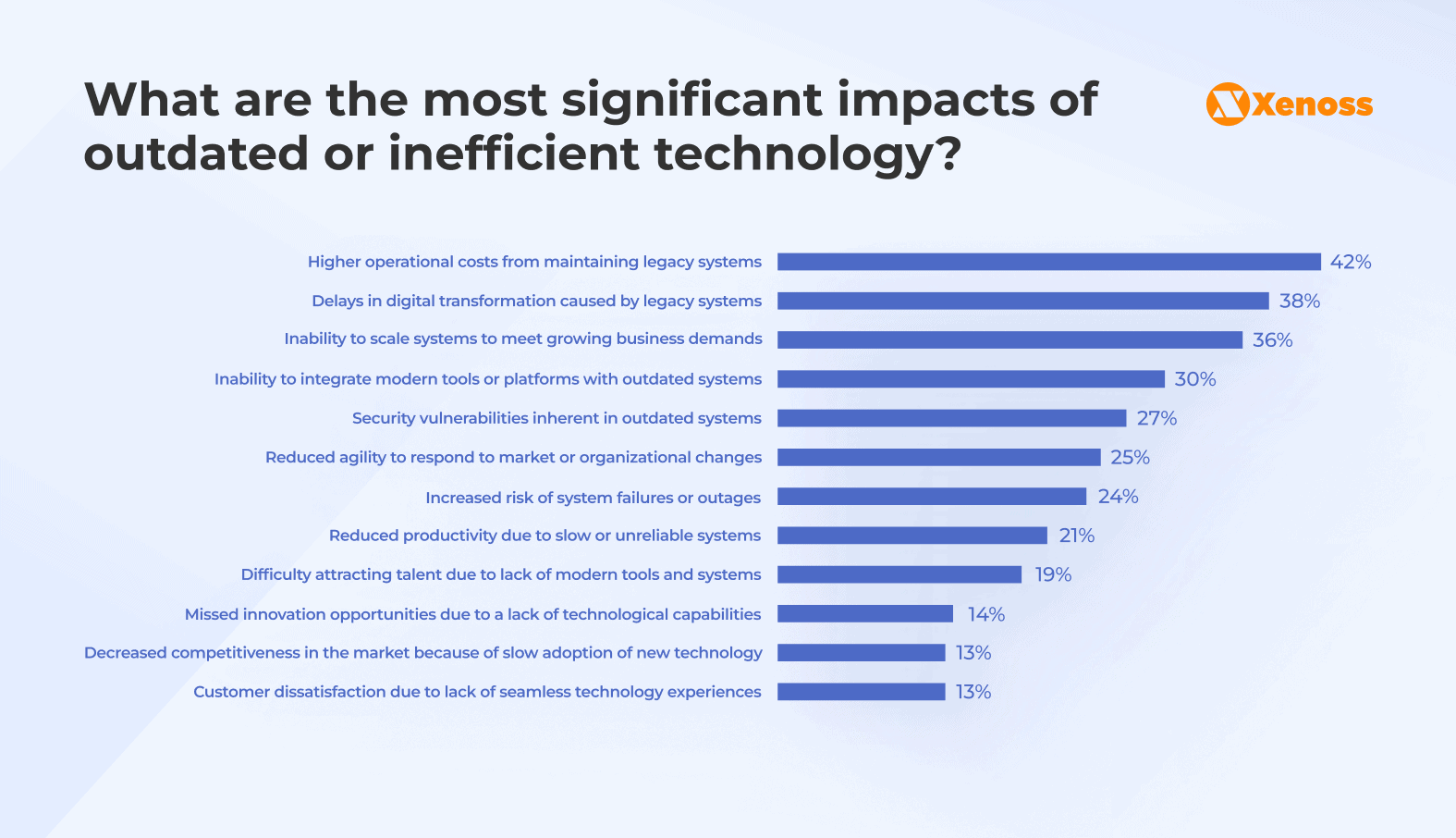
Quantified delay costs
Operational cost escalation: 42% of enterprise decision-makers report that maintaining outdated software significantly increases operational costs, and
Digital transformation barriers: 38% and 36% of respondents struggle with digital transformation and software scalability issues, respectively.
Security issues: Older systems often lack modern security protocols because vendors no longer support them, leaving them more vulnerable to cyber threats. 42% of business leaders cite enhanced security as one of the top priorities for application modernization.
Compliance bottlenecks: As data privacy regulations such as GDPR and CCPA become more stringent, legacy systems lack the architectural flexibility to ensure compliance, exposing organizations to hefty fines and reputational damage.
The decision to keep legacy systems as-is is riskier because these systems affect other internal software, decrease employee productivity, and require frequent, costly fixes. You may need to invest more upfront in their modernization, but this investment eventually pays off in improved customer experience, employee satisfaction, and enhanced business services.
Plus, modernization makes your business more resilient in response to market changes. You become more competitive and better prepared for integrating new technologies such as AI and ML.
Modernization paths: Choosing the right approach
There is no single “best” way to modernize legacy software. The right approach depends on how critical the system is to your business, how much operational risk you can tolerate, and what outcomes you are trying to achieve.
The foundational step in any modernization journey is a thorough assessment of your entire application portfolio against key business criteria:
- Business impact analysis
- Revenue criticality: Direct revenue dependence and customer-facing impact assessment
- Operational centrality: Mission-critical process dependence and business continuity requirements
- Strategic alignment: Future business model support and competitive advantage potential
- Regulatory requirements: Compliance obligations and audit trail maintenance needs
- Technical condition evaluation
- Architecture assessment: Monolithic vs. modular design, integration complexity, scalability limitations
- Security posture: Current vulnerabilities, patch management status, encryption capabilities
- Code quality: Technical debt volume, documentation completeness, maintainability score
- Performance metrics: Response times, throughput capacity, reliability statistics
- Financial analysis
- Total cost of ownership: Licensing, infrastructure, maintenance, support costs
- Modernization investment: Development, migration, training, operational transition costs
- ROI projections: Business value realization timeline and financial return expectations
- Risk quantification: Potential loss from delays vs. transformation investment
- Integration and dependency mapping
- System interdependencies: Data flows, API connections, shared database relationships
- Vendor relationships: Third-party integrations, support agreements, licensing constraints
- Operational workflows: User processes, automation dependencies, reporting requirements
- Change impact radius: Systems affected by modernization decisions
This assessment allows you to prioritize your efforts, focusing on high-impact, high-value applications first and choosing the most appropriate modernization strategy for each one. The Red Hat survey revealed that 41% of organizations first modernize their core backend applications, 35% – their data analytics and BI apps, and 14% – customer-facing ones.
Modernization projects fail when organizations default to a one-size-fits-all approach across application types. But successful modernization starts with understanding which strategic modernization options are available and the trade-offs each brings.
Incremental vs. full replacement
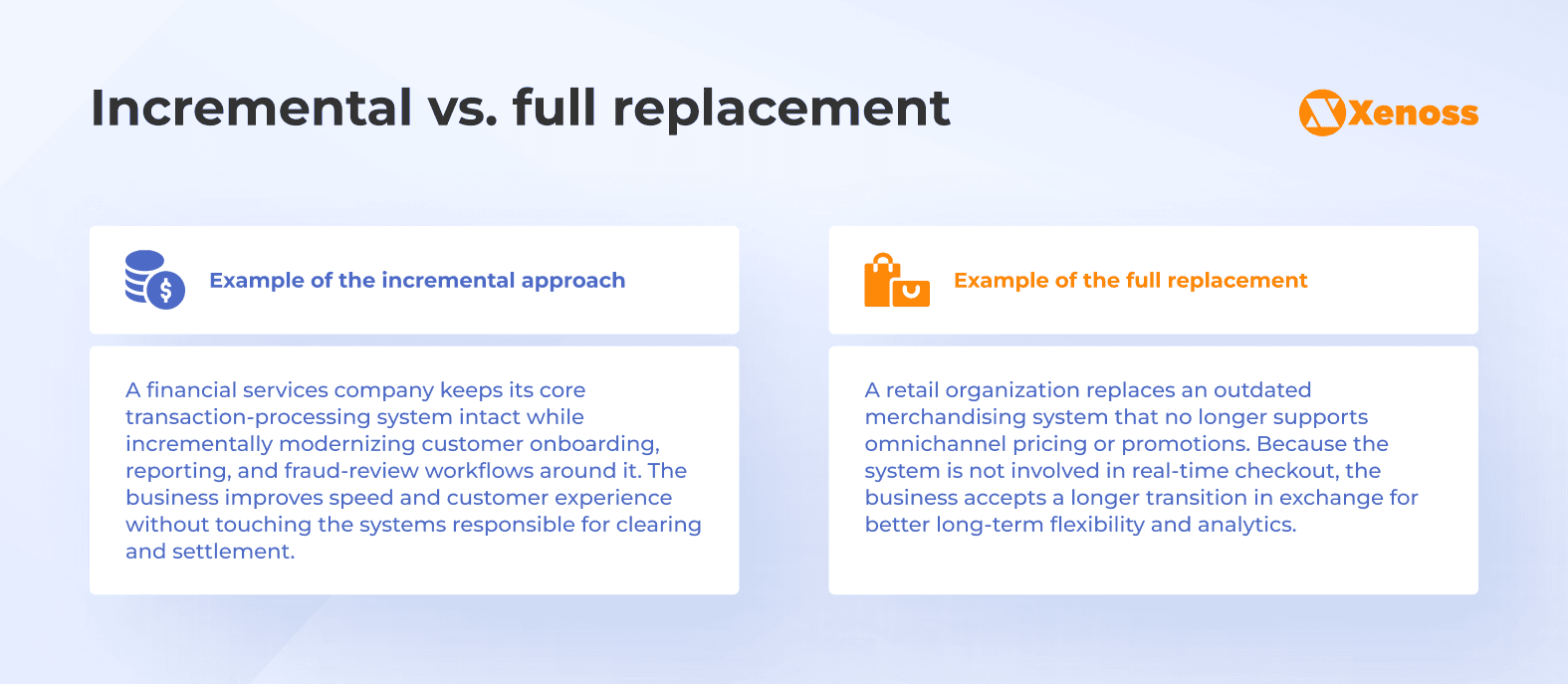
One of the first decisions business leaders make is whether to modernize existing systems gradually or replace them outright.
Incremental modernization focuses on improving systems step by step while they remain in use. When businesses decide on this approach, they can spread investment over time, reduce operational risk, and realize value earlier. It is often the preferred path for systems that support daily operations, revenue processing, or regulated activities.
Full replacement, on the other hand, aims to replace a legacy system with a new one. While this approach can promise a cleaner long-term foundation, it carries a higher upfront cost, longer timelines, and a greater risk of delays or disruption.
Parallel run vs. cutover
Another critical decision is how to introduce change into live operations.
A parallel run approach allows new and existing systems to operate side by side for a period of time. Running old and new systems in parallel gives teams the ability to validate results, manage risk, and gradually transition data and users to the new system.
A cutover approach switches from the outdated systems to the new ones at a defined point in time. It can reduce short-term costs and complexity, but it concentrates risk into a single moment.
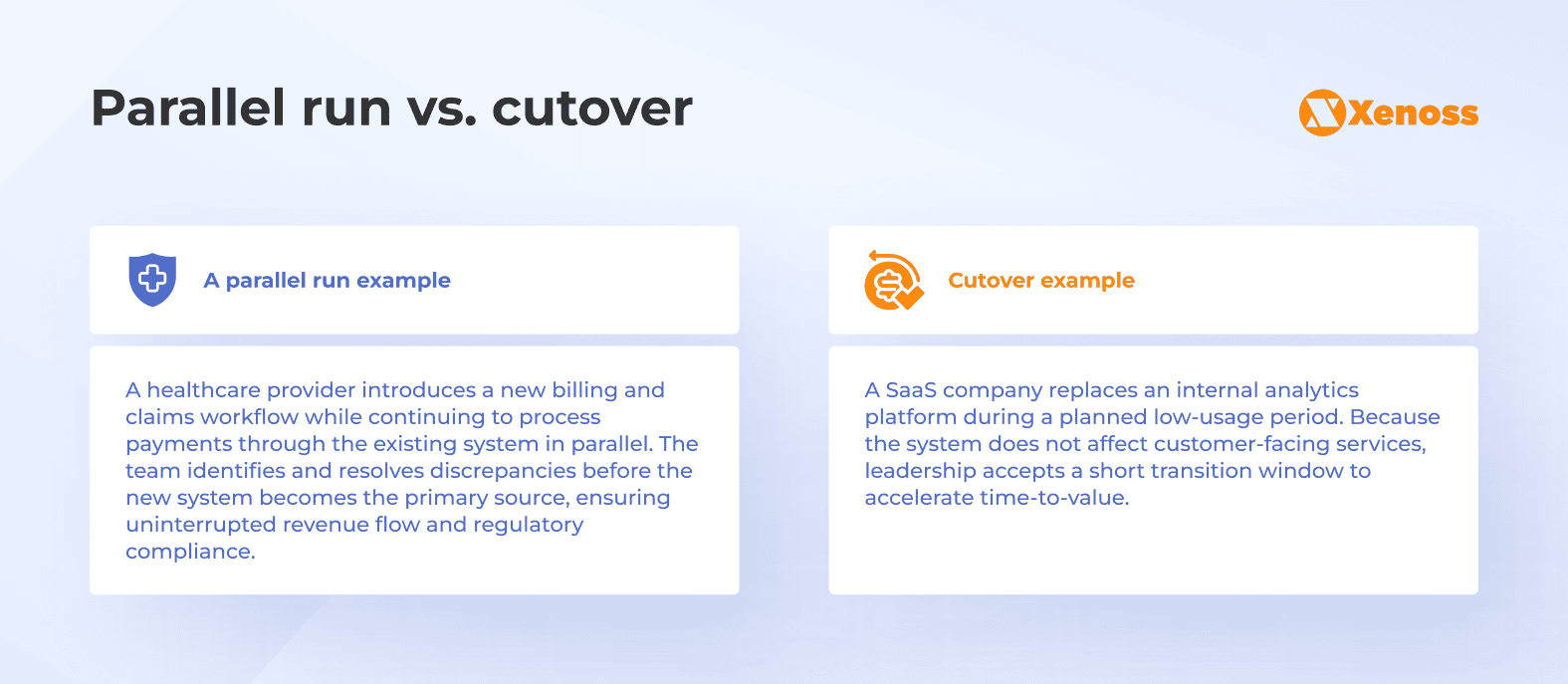
For business leaders, the choice often comes down to control versus speed. Parallel runs favor resilience and predictability, while cutovers favor faster transitions but require a thorough risk assessment during the pre-cutover phase.
Encapsulation vs. reinvention
Modernization does not always require changing how a system works internally.
Encapsulation focuses on preserving existing business logic while improving how the application interacts with internal and external services by wrapping legacy code with modern APIs. This technique allows companies to protect years of accumulated knowledge and processes while removing bottlenecks in data exchange.
Reinvention involves rethinking processes and capabilities from the ground up. Using this method can help you develop new business models and improve customer experiences, but it also requires deep organizational alignment and significant investment.
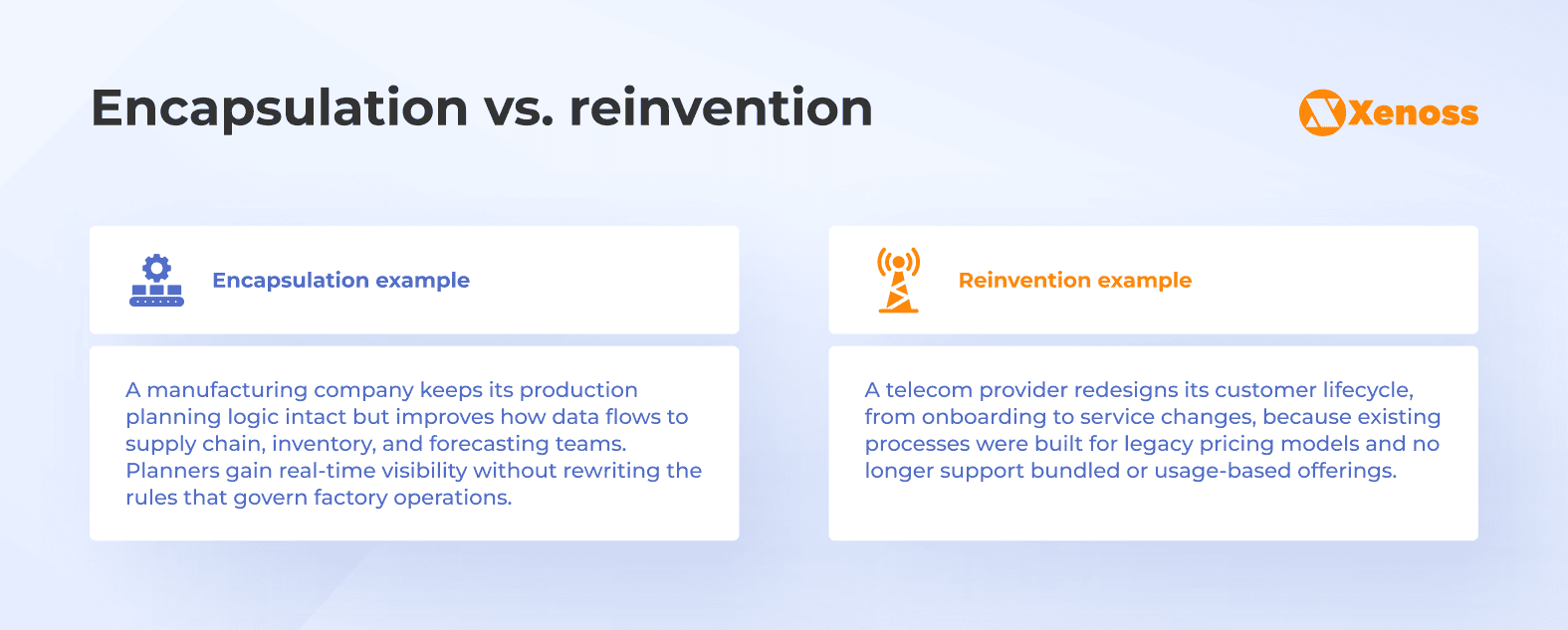
From a return-on-investment standpoint, encapsulation often delivers faster, lower-risk gains, while reinvention is a longer-term bet aimed at transformational change.
In practice, most organizations apply different modernization paths, or combinations of them, to different systems. Critical platforms may evolve incrementally with parallel validation, while less critical applications are replaced or reimagined more decisively.
The role of leadership is to set clear priorities: decide where stability must be preserved, where speed matters most, and where transformation will deliver meaningful business value.
Technologies that support non-disruptive business modernization goals
The technologies that underpin application modernization, such as cloud, microservices, DevOps, and AI, directly translate into the business capabilities required to win in the modern economy: speed, scalability, and efficiency.
Cloud advantage: Scalability, resiliency, and cost optimization
Cloud migration lies at the center of most modernization efforts. The cloud provides on-demand scalability, allowing your applications to handle peak loads without the cost of maintaining idle legacy infrastructure.
Cloud-native architectures are built to keep services running even when individual components fail, reducing the likelihood and impact of outages on customers and operations.
Plus, cloud deployment helps businesses shift technology spending from a capital expenditure (CapEx) model of buying servers to an operational expenditure (OpEx) model, allowing you to pay only for the resources you use and align costs directly with business activity.
Migrating to the cloud-managed services also involves planning out a thorough data migration process. It consists of selecting, preparing, and migrating data from on-premises to the cloud or a hybrid environment.
Source: kubus IT
Microservices and containers: Driving flexibility and faster innovation
Legacy application modernization often involves decoupling monolithic architectures into a manageable, loosely coupled microservices architecture. For simplified and consistent deployment, each service is containerized using tools such as Kubernetes or Docker.
Where legacy applications are large, monolithic blocks, a modern architecture based on microservices is like a set of interconnected LEGO bricks. Each “brick” is a small, independent service responsible for a single business function. In our detailed architecture guide, we cover the architecture patterns for implementing microservices.
The essence of this application architecture is in its flexibility. Small, autonomous teams can work on different services simultaneously without interfering with each other, accelerating development cycles.
For instance, if you need to update your payment processing, you only touch the payment service, not the entire application. This reduces the risk of unexpected changes and allows you to roll out new features and respond to market demands faster than you could with a monolithic legacy application.
Source: Uber
DevOps: Accelerating delivery, enhancing quality, and reducing risk
DevOps is a cultural and operational philosophy that bridges the traditional gap between software development (Dev) and IT operations (Ops). It focuses on automation and collaboration to build, test, and release software faster and more reliably. For the business, this means a significant acceleration in time-to-market.
The extensive use of automation tools in testing and deployment catches errors early. It reduces the risk of manual mistakes, leading to higher-quality, more stable releases, which are particularly crucial during the application modernization stage.
Source: government institution
AI in intelligent modernization
According to McKinsey, using AI-driven modernization tools, companies can accelerate legacy transformation timelines by up to 40%–50%.
Artificial intelligence tools can analyze vast legacy codebases to identify dependencies, automatically map business processes, and even suggest the most efficient modernization ways. With this technology, companies can reduce the manual effort and guesswork involved in the initial assessment phase, de-risking the project from the start.
In response to a question about using AI tools for application modernization posted on the Gartner Peer Community site, the VP of Information Security described their use of AI as follows:
We continue to explore and use AI tools for application modernization. At this point in time, we have been exploring or using [AI] for the following:
1. Code analysis and understanding
2. Automated code refactoring and transformation
3. Test case generation and automation
4. API generation and management
5. Security vulnerability detection and remediation
6. Database migration and optimization.
Source: Morgan Stanley
In every case study we covered, technologies solve a particular business problem and are a part of custom modernization roadmaps. The next step for leadership is to track these modernization initiatives against clear success metrics, so that modernization progress translates into tangible returns and long-term business resilience.
Measuring success of application modernization: ROI, TCO reduction, SLA adherence, and compliance
Effective leaders define success upfront and measure modernization against four non-negotiable dimensions: financial return, cost structure, operational reliability, and risk exposure.
| Success criteria | What leaders should measure | What it signals to the business |
|---|---|---|
| Return on investment (ROI) | Time-to-market for new features or services Revenue uplift from new digital capabilities Reduction in manual work or process bottlenecks | Modernization is creating business opportunities, not just consuming the budget |
| Total cost of ownership (TCO) | Ongoing maintenance spend Frequency of emergency fixes Cost predictability across systems | Financial control has replaced reactive spending |
| Service reliability (SLA) | System availability during and after the change Incident frequency and recovery time Customer-facing disruption | Modernization is increasing resilience without operational risk |
| Operational efficiency | Time spent on manual workarounds Cross-team dependencies Speed of internal processes | Teams can focus on value creation instead of firefighting |
| Compliance & risk exposure | Audit readiness Security incidents or near misses Regulatory exceptions | Risk is actively managed rather than tolerated |
| Organizational agility | Ability to adapt systems to new regulations or market demands Effort required to support change | The business can evolve without major disruption |
| Customer experience impact | Customer satisfaction or retention trends Service continuity during upgrades | Customers feel progress without feeling the change |
| Leadership confidence | Predictability of outcomes Clarity of decision-making | Modernization is under control and strategically aligned |
Final takeaway
This business-focused modernization article is the last one in our series of application modernization guides. So far, we’ve covered de-risking strategies for modernization, approaches to selecting modernization vendors, migration strategies for COBOL-based software, and the selection criteria of an appropriate architecture approach for the modernization project.
Our aim with this last piece of the puzzle was to debunk any remaining concerns or myths about modernization. You now realize why postponing modernization can pose more risks than modernization itself and why modern businesses should seek new ways to remain competitive.
The selection of the modernization path and technologies depends on how mission-critical your application is and how deeply it’s embedded into your IT infrastructure. Xenoss can help you estimate the complexity of your current legacy stack and, based on the findings and with the help of AI-assisted engineering tools, develop the most appropriate software modernization roadmap.