
In 2022, the Canadian telecommunications company Rogers experienced a 26-hour outage affecting 12 million users. Customers lost internet access, mobile connectivity, or even 911.
The issue was resolved eventually, but the company hired an analytics firm to determine that the root cause was a failure in the seven-phased network upgrade. After completing five phases, the risk algorithm downgraded the risk level of the sixth phase from “high” to “low”, leading to a fatal mistake. Due to the low risk level, employees didn’t perform the necessary audits and approvals, and made an error in configuring distribution routers. As a result, lots of IP data flooded the core network, causing an outage.
To prevent similar failures, Rogers invested heavily in strengthening change management practices, improving incident response, and refining their risk assessment algorithms.
This incident highlights a critical lesson: modernization is not dangerous when technology is outdated. It becomes dangerous when risk is underestimated.
Experienced external engineering teams can help reduce modernization risks, accelerate delivery, and maintain business continuity through extensive system audits and IT infrastructure preparation.
This guide provides CIOs with a framework for working effectively with external teams to de-risk legacy system modernization initiatives. We cover common modernization approaches, risk mitigation strategies, governance controls, and methods for comprehensive vendor evaluation.
What makes legacy modernization difficult
Despite years of digital transformation initiatives, 62% of organizations still rely on legacy software systems, and 25% of organizations are legacy-heavy, meaning their business processes will inevitably stop if they consider updating their core systems. Only 30% of organizations have fully modernized their environments.
These findings prove that modernization projects are inherently complex, touching every business aspect, from core mainframe processes to customer-facing applications. The risks are substantial: operational disruption, budget overruns, data migration failures, and security vulnerabilities.
A senior IT Leader at a healthcare enterprise said,
We’re spending millions on modernization, but the problem isn’t just legacy code. It’s how we think. The decisions that led to this architecture are still being made the same way.
Companies often underestimate the complexity of their systems, continue to make incremental decisions based on past assumptions, or attempt modernization without the right safeguards. As a result, even well-funded efforts fail to produce meaningful ROI.
Modernization difficulty is rooted not only in outdated software but in people, processes, and organizational habits. That’s where external partners can be helpful. Apart from performing system updates, experienced specialists also offer value-added legacy app modernization services, such as team training or integration into your in-house team to help them adjust to the new way of working.
Legacy application modernization explained: Approaches and risks
The table below includes 11 approaches to legacy software modernization. One of the newest is AI augmentation, which means enhancing legacy system performance, features, and user experience with AI. In fact, 80% of business leaders trust AI to improve their modernization efforts. In our CTO guide, we explain how to integrate these systems with AI to ensure minimal disruption and maximum efficiency.
AI can also be used to accelerate most of the modernization approaches below, or even help you efficiently combine them. For instance, engineers can use AI to rewrite legacy application code and then rehost it in the cloud. This way, a business can rehost fully updated software quickly and cost-effectively, compared to a manual application rewrite, which can be expensive.
The Fintech company Qonto developed a web-based AI assistant to rewrite Ember code to React and modernize the UI of their mission-critical web application. The results exceeded their expectations: from 50 lines of code per engineer, they achieved 1,000 lines of code per engineer, without any significant drop in quality and consistency. This speed inspired them to improve the AI assistant further and integrate it as an extension for VS Code to enable even faster development in the future.
This outcome is common among organizations that modernize successfully: modernization becomes a catalyst for broader optimization, innovation, and operational reinvention.
| Approach | What it means | When to choose it | Pros | Cons |
|---|---|---|---|---|
| Rehosting (lift-and-shift) | Moving the existing application as-is to modern infrastructure (e.g., on-prem → cloud). | When you need quick cost savings, want to exit data centers, or reduce infrastructure overhead fast. | • Fastest modernization path • Lower upfront cost • No code changes | • Doesn’t improve architecture or UX • Legacy issues remain • Limited long-term ROI |
| Replatforming (lift-tinker-and-shift) | Making minimal changes to use modern platforms (e.g., move from Oracle DB to Aurora, update runtime). | When you want moderate improvement without a major rewrite; the app is stable but needs better performance/scalability. | • Reduces licensing costs • Better performance • Limited refactoring effort | • Changes may reveal hidden dependencies • Not a long-term architectural fix |
| Refactoring/re-architecting | Restructuring the codebase and architecture without changing core functionality. | When technical debt slows delivery, the system must scale, and cloud-native benefits are needed (containers, microservices). | • Improves performance, maintainability • Enables CI/CD, autoscaling • Reduces operational risk | • High complexity • Requires deep domain expertise • Longer timelines |
| Rewriting/full replacement | Building the system from scratch using modern technologies while preserving business logic. | When the legacy system is too rigid/fragile; a complete overhaul is cheaper than current software maintenance; the future roadmap requires flexibility. | • Clean architecture • Long-term ROI • Enables new features and UX overhaul | • Highest risks and cost • Long delivery cycle • Data migration complexity |
| Migration to packaged SaaS/commercial off-the-shelf (COTS) | Replacing the legacy system with off-the-shelf solutions (e.g., Salesforce, SAP S/4HANA, Temenos). | When business processes match market standards; customization isn’t a priority; rapid modernization is needed. | • Fast deployment • Lower maintenance • Built-in compliance & best practices | • Vendor lock-in • Limited customization • Potential process reengineering needed |
| Modular decomposition/strangler pattern | Slowly replacing pieces of the legacy system with modern services/APIs until the old system is entirely removed. | When the system is too risky for a big-bang migration, or you need continuous delivery without downtime. | • Reduces risk • Incremental value • Works well with microservices | • Requires careful orchestration • May increase complexity in the short term |
| UI/UX modernization layer | Keeping backend legacy, but rebuilding the frontend or adding an API layer on top. | When UX/business workflows are outdated but backend logic is stable; a customer-facing upgrade is needed fast. | • Quick visible impact • Low risk • Improves adoption • Supports future migration | • Backend limitations remain • Full modernization is still needed later |
| Encapsulation via APIs/integration layer | Wrapping legacy functionality in APIs, enabling external systems to access it without touching the core. | When modernization must coexist with a legacy stack; if you want to enable integrations, RPA, and automation. | • Non-invasive • Enables RPA, microservices, event-driven extensions • Buys time for bigger modernization | • Doesn’t remove legacy tech • May lead to a complex patchwork of the tech stack |
| Automated code translation (e.g., COBOL → Java) | Using tools to convert legacy code to modern languages with minimal manual rewriting. | When the codebase is huge, and a rewrite is unrealistic; the team lacks COBOL skills. | • Faster than manual rewrite • Preserves logic • Reduces dependency on retiring talent | • Accuracy depends on translator tools • May carry poor architecture forward |
| Containerization | Packaging legacy applications into containers (e.g., Docker and Kubernetes) to improve portability and operations. | When you want cost-efficient scaling and DevOps automation without rewriting. | • Improves deployment speed • Simplifies infra management • Works with outdated apps | • Doesn’t fix code-level issues • Some apps aren’t container-friendly |
| AI augmentation | Using AI to automate workflows around the legacy system instead of modifying the system itself. | When modifying legacy code is impossible; you need automation quickly, or want to extend without touching the core. | • Fast ROI • Low risk • Works with any system | • Adds operational overhead • Doesn’t address core tech debt |
Select a modernization technique (or several of them) based on your current priorities. If you need quick results for your customers, select UI/UX update and modular improvement. If you have time and need a reliable, modern solution for another decade or two, consider a complete overhaul.
To avoid risks along the way, entrust the modernization process to the experienced vendor.
4 modernization risks and how trusted partners can mitigate them
Over the last decade of delivering enterprise modernization projects, our team has seen the same four risks repeatedly derail timelines, inflate budgets, and disrupt business operations. Below are the most common challenges and how experienced external engineering partners systematically de-risk them.
Risk #1. Technical debt
Technical debt is the cost businesses pay when they choose an easy, limited solution now rather than a better approach that would take longer. The debt often appears as poorly documented code, outdated legacy databases, monolithic architectures, and a tangled web of dependencies that make any change risky and time-consuming.
Accumulated tech debt consumes around 40% of enterprise IT budgets for maintenance alone. Conducting a modernization project without a clear strategy to manage and pay down this debt is like building a new structure on a crumbling foundation. Failure is almost inevitable.
De-risking strategy
A dedicated external partner brings a fresh perspective to the challenge of tech debt. Unlike internal teams who are attached to historical decisions, an experienced vendor can evaluate architecture, code quality, and dependencies without emotional bias. Best-in-class partners use a proprietary technical debt management framework to systematically identify, prioritize, and remediate debt as part of the modernization process.
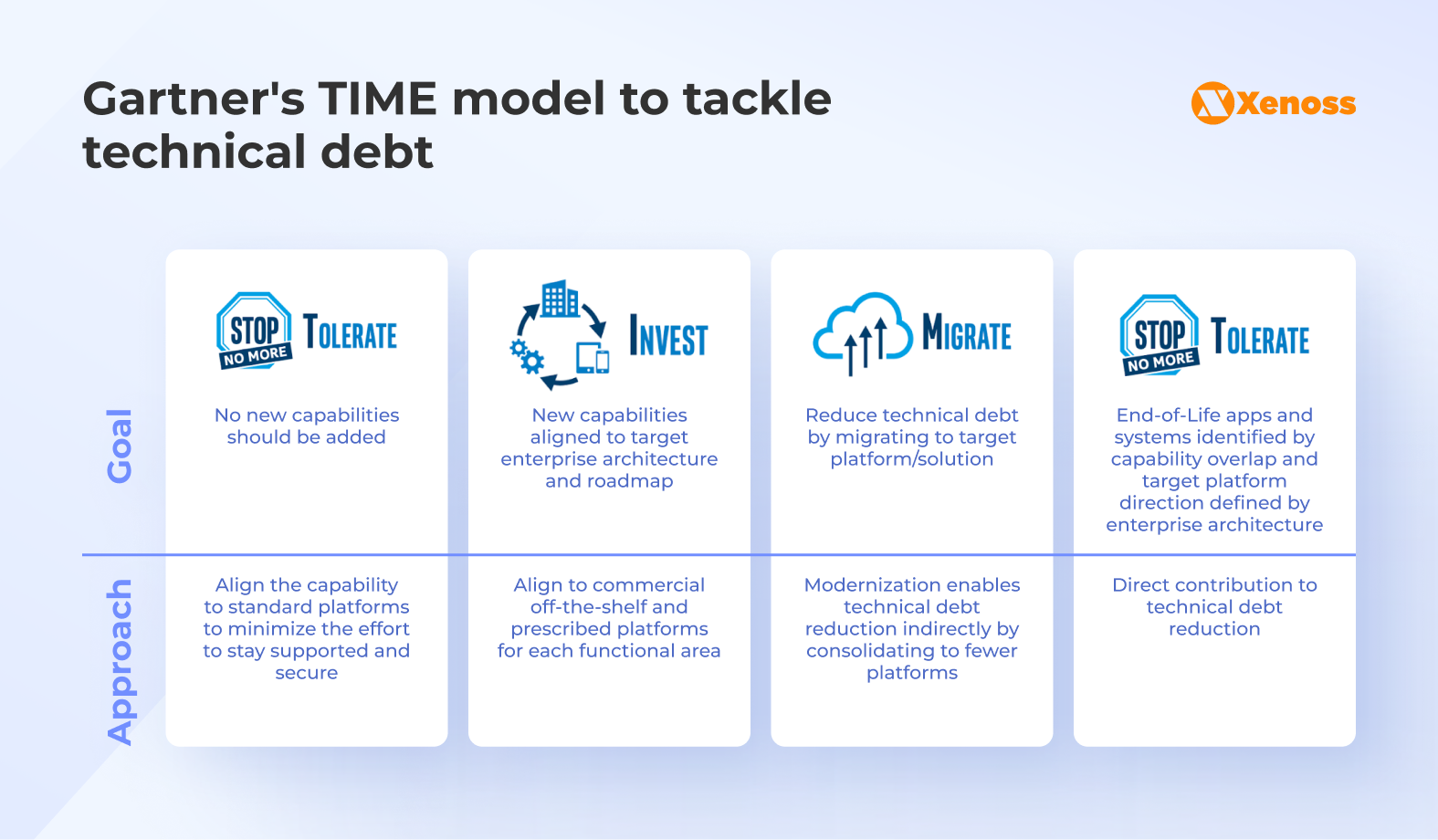
For instance, Intel applies Gartner’s strategy, tolerate, invest, migrate, and eliminate, to assess technical debt and define which steps to take, as sometimes the application’s debt achieves such a limit that the only way out is to eliminate the system.
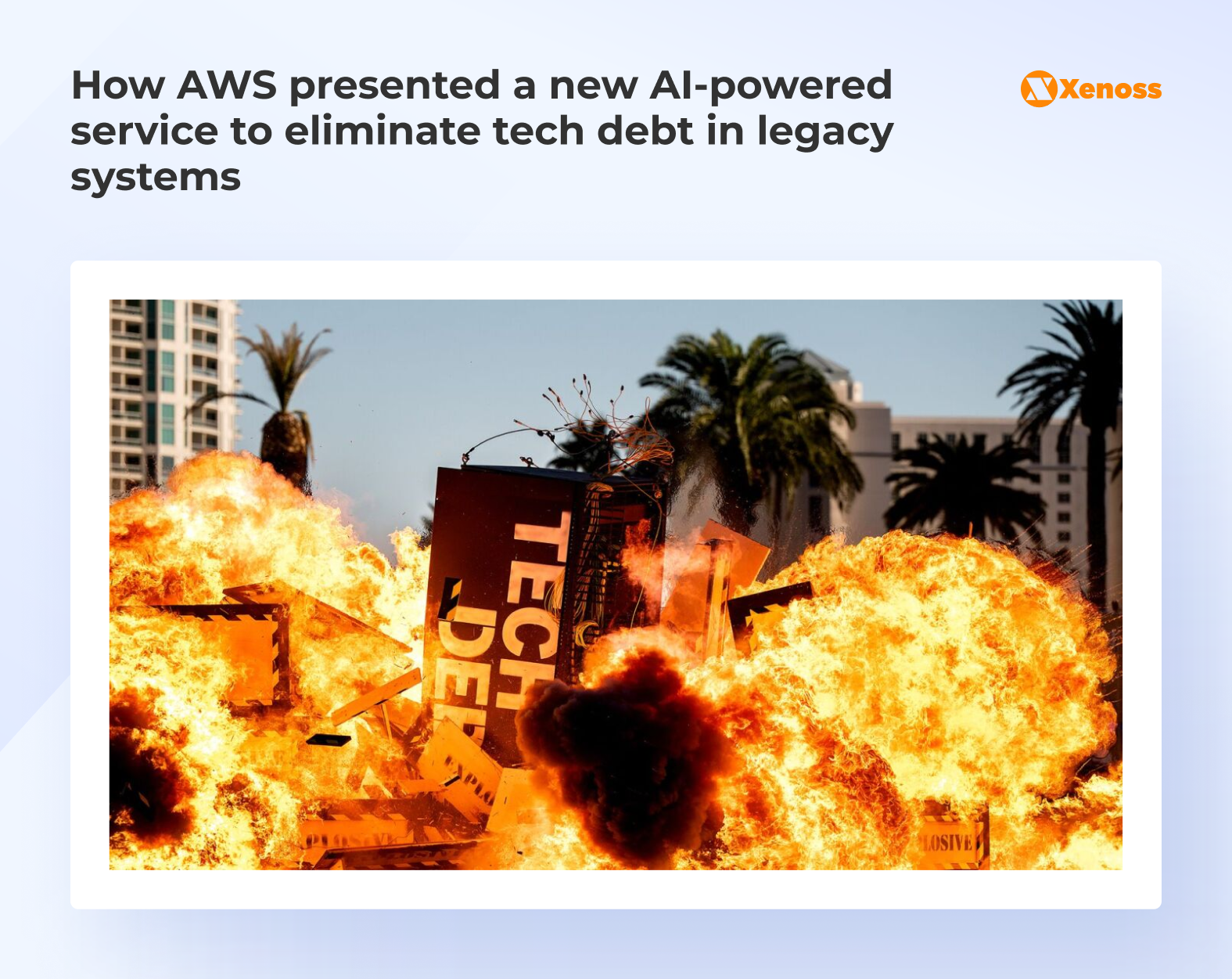
AI-driven tools are also transforming debt remediation. Recently, AWS introduced its new service, Amazon Transform, built on agentic AI and designed to help businesses optimize legacy modernization. So far, the service has helped customers eliminate tech debt and accelerate modernization by up to 5 times across all layers. At re: Invent 2025, AWS destroyed a decommissioned server rack as a figurative demonstration of what their new service can do to the tech debt in legacy systems.
In addition, external partners embed modern engineering practices into the modernization lifecycle:
- automated testing
- continuous integration/continuous deployment (CI/CD)
- rigorous code reviews.
By embedding quality assurance throughout the development lifecycle, they prevent the creation of the new “modernization debt”, which, apart from technical issues, also includes operational and business challenges as a by-product of the failing modernization.
Quality-first engineering ensures the final modernized system is resilient, maintainable, and cost-efficient to operate.
Risk #2. Operational and integration complexities
The risk of disrupting core business functions during a modernization effort is a primary concern for every CIO. A “big bang” replacement is rarely feasible, as it would require either migrating all business data to the cloud at once or completely rebuilding the system and stopping business operations during this period. Instead, organizations choose a parallel modernization process where new and old systems run simultaneously.
Legacy modernization also introduces significant integration complexities. CIOs may ask themselves:
- How do we synchronize data between a 40-year-old mainframe and a modern cloud platform?
- How do we expose legacy functionality through modern APIs without compromising performance or security?
Failure to properly manage these integrations can lead to data corruption, business process failures, and a downgraded customer experience.
De-risking strategy
It’s crucial for external partners to have deep cloud expertise to design and implement modern architectures that sustain core business services. They should be capable of building hybrid and multi-cloud architectures that eliminate single points of failure and ensure high service availability.
As a part of legacy application modernization services, experienced vendors can also refactor monolithic applications into scalable and easy-to-maintain microservices that can be independently deployed and scaled, improving system performance and agility.
To overcome integration challenges, engineering partners can develop a hybrid integration platform (HIP) that includes an event-driven architecture to enable continuous data exchange between on-premises and cloud environments.
Data is often trapped in legacy databases and mainframe processes, making it inaccessible for modern analytics and AI. A key de-risking tactic is to decouple the data layer. This involves creating a modern cloud-based data platform that synchronizes with legacy systems in near real-time.
By building robust data pipelines, using custom APIs, and data connectors, partners can integrate legacy datasets without disrupting core operations.
Risk #3. Resource, skill, and capacity gaps
The skills needed to modernize and maintain legacy systems are crucial when selecting the right partner. Expertise in cloud technologies, microservices, containerization, and modern data architectures is in high demand and short supply. And 74% of employers report difficulty filling IT roles, creating a significant skills gap. Internal teams, already stretched thin with day-to-day operations, often lack the specific experience and capacity to undertake a large-scale modernization project.
Without the right expertise, teams may make poor architectural decisions, underestimate complexity, and struggle to adopt modern agile development practices, leading to delays, increased costs, suboptimal outcomes, or business disruption, as happened to Rogers described earlier.
De-risking strategy
Instead of spending months hiring for niche skills in a competitive market, CIOs can instantly access teams with proven experience in cloud platforms, data engineering, and agile architectures.
Look for partners who have executed similar complex transformations for other organizations. They bring not only technical proficiency but also battle-tested methodologies and development best practices. They understand the common pitfalls of migrating legacy databases, refactoring mainframe applications, and building resilient architectures.
Risk #4. Security and compliance vulnerabilities
Legacy systems represent a massive and growing security risk. They often lack modern security controls, are difficult to patch, and may run on unsupported hardware or operating systems, making them susceptible to cyberattacks. The global average cost of a data breach reached $4.44 million in 2025.
Plus, these systems may not meet current regulatory and compliance standards, such as GDPR or CCPA, exposing the organization to significant legal and financial penalties. Modernization efforts must address these security and compliance gaps from day one.
De-risking strategy
External engineering partners bring specialized cybersecurity expertise that is often lacking in-house. They understand the threats of the modern cloud environments and know how to design secure architectures from the ground up. During modernization, they implement DevSecOps practices, integrating security controls and testing directly into the development pipeline.
They can help migrate from outdated authentication systems, implement robust identity and access management (IAM), encrypt data both in transit and at rest, and ensure the new environment meets all relevant compliance requirements.
This proactive approach transforms security from a reactive bottleneck into an integrated component of the modernization process, reducing the risk of a breach both during and after the transition.
Choosing the right external engineering partner
Engineering partners generally fall into several archetypes. Each brings different levels of accountability, expertise, and strategic value. Understanding these differences helps CIOs avoid misalignment and select a partner capable of delivering modernization safely and predictably.
- Staff augmentation. These firms provide individual developers to supplement your existing team. They are best for filling temporary capacity gaps but typically offer little strategic guidance or project ownership, thereby shifting most of the risk management to you.
- System integrators (SIs). Large SIs are proficient at implementing enterprise software packages (e.g., SAP, Oracle) and managing large-scale projects. They can be effective but may be less flexible and sometimes prioritize their own technology stack over what is truly best for your architecture.
- Boutique specialists. These smaller firms offer deep expertise in a specific niche, such as data engineering, cloud-native development, or a particular industry. They can provide immense value but may lack the scale for a massive end-to-end transformation.
- Strategic engineering partners. This is the ideal archetype for de-risking complex modernization. These partners act as true collaborators, taking co-ownership of the outcomes. They bring a blend of strategic consulting, deep technical expertise, and proven delivery frameworks. They challenge assumptions, provide proactive guidance, and focus on building long-term capability within your organization.
If you need end-to-end legacy software modernization services that can serve as a blueprint for subsequent modernization projects, a strategic engineering partner is your go-to option.
Vendor selection criteria for legacy modernization
Here’s a concise roadmap to selecting the right vendor. Pay particular attention to the questions to ask and red flags.
| Selection criterion | Questions to ask during evaluation | Red flags 🚩 |
|---|---|---|
| Proven modernization framework | • What is application modernization at your company? • Can you walk us through two real modernization case studies? • How do you assess tech debt and architecture readiness? | No structured methodology; generic “we’ll analyze and propose”; inability to show real modernization artifacts. |
| Deep cloud, data, and architecture expertise | • Are your engineers certified (AWS/GCP/Azure)? • What’s your approach to decomposing monoliths? • How do you ensure scalability, resilience, and security? | Cloud buzzwords only; no certified team; limited experience with distributed/high-load systems. |
| Strong governance & communication model | • What does your governance model look like? • How do you report progress and surface risks? • How do you handle changes or exceptions? | Vague governance description; no defined cadence; reactive communication. |
| Cultural fit & collaboration style | • How do you collaborate with in-house teams? • How do you share knowledge? • How do you handle disagreement or misalignment? | “Just give us requirements,” minimal transparency, no knowledge transfer. |
| Focus on business outcomes | • How do you measure modernization success? • What KPIs have you improved in past projects? • How do you align with business goals? | No KPI alignment; focus only on delivery; can't quantify impact. |
| Engineering maturity (CI/CD, DevOps, testing) | • Describe your CI/CD setup. • How do you manage QA for legacy systems? • Do you support site reliability engineering (SRE) or performance engineering? | Manual deployments, no automated testing, and limited observability. |
| Data migration & integration competency | • How do you handle complex data migrations? • Do you use change data capture (CDC)/event streaming? • How do you guarantee zero downtime? | No rollback plan; vague about data complexity; missing data migration framework. |
| Security, compliance & DevSecOps | • How do you integrate security early in the process? • Are you compliant with our standards (ISO/SOC2/GDPR/HIPAA/PCI DSS)? | No security lead; bolted-on security; lack of certifications. |
| Scalability & performance engineering | How do you ensure the system scales post-migration? • What load tests do you run? • What service level objectives (SLOs) do you set? | No load testing; no SLOs; vague claims about scalability. |
| Post-modernization support & knowledge transfer | • How do you ensure our team can fully own the system? • What documentation is included? • Is optimization part of your engagement? | No enablement plan; hidden support fees; vendor lock-in tactics. |
| Financial & delivery transparency | • What pricing model do you use? • How do you prevent budget overruns? • How do you handle scope changes? | Vague estimates; hidden fees; inability to forecast. |
Bad news: with the wrong partner, legacy modernization can fail. Good news: but such a scenario can be either entirely disruptive to your business or simply a lesson learned and a mark on your vendor qualification checklist to “never work with this vendor again”.
The outcome depends on how you step into these relationships: fully protected, or with “huge holes” in the contract that leave you vulnerable to misuse of your business data.
You’re not necessarily going to work with the wrong vendor, but taking care of protecting your business boundaries is essential, irrespective of which vendor you end up working with.
Governance structures that prevent vendor lock-in and scope creep
Robust governance protects modernization programs from misalignment, hidden risks, budget drift, and vendor dependency. The structures below have been repeatedly proven to safeguard companies during large-scale external engagements.
Set clear SLAs and KPIs from day one
Service-level agreements create accountability and define performance targets that directly align with business outcomes rather than focusing solely on technical metrics. Effective SLAs reflect what matters most to the business:
- App availability during peak hours
- Zero data loss in financial transactions
- Fast customer-facing API responses
- Reliable data synchronization between systems
Customize your SLA to fit the exact business needs and ensure it’s concise, understandable, and feasible. Instead of creating one overly complex SLA, you can compose a sequence of smaller and more understandable ones. Your internal and external teams should be able to grasp the meaning quickly. If they struggle, consider rewriting or updating an SLA.
After laying the groundwork for cooperation with the SLA, work with your partner to define and track meaningful metrics beyond budget and schedule. Monitor technical KPIs, such as system uptime, API response times, and code quality, and also track business-oriented KPIs, such as user adoption rates and operational efficiency. Regular review of these metrics allows for data-driven decision-making.
Ensure compliance and security alignment
Build security and compliance frameworks that include:
- A detailed review of your current environment (legacy mainframe, old applications, existing processes) to understand which security controls you already have and what compliance rules you currently meet.
- Comparison of your old system and your future cloud-based system security posture against the regulations you must follow (GDPR, HIPAA, PCI DSS, SOC 2).
- Security validation checkpoints to monitor during the modernization project.
- Complete audit trails documenting all changes made during and after modernization.
Enable automated regression testing
Regression testing catches integration failures before they reach production environments. These tests identify compatibility issues early in the modernization process, preventing costly rollbacks and system outages.
For instance, when migrating customer data from DB2 to a cloud database, regression tests compare fields, formats, and historical data outputs to ensure no records are lost or corrupted. These automated checks run every time the modernization team makes an update, providing confidence that critical workflows (payments, onboarding, order processing, credit decisions) stay reliable throughout the transformation.
Measuring de-risking ROI
The ROI from a modernization project extends beyond simple cost savings. A significant component of the value comes from quantifiable risk reduction. This can be measured in several ways:
- Calculate the reduction in security risk by quantifying the potential cost of a data breach in the legacy system versus the modern environment.
- Measure the reduction in operational risk by tracking decreases in system downtime, outages, and critical errors.
- Assess the reduction in talent risk by measuring the cost to hire and retain scarce legacy skills versus the availability of modern development talent.
Presenting these risk reduction metrics to the board demonstrates that the investment is not just about new technology, but about building a more resilient and secure enterprise.
Bottom line
Modernization is often seen as a risky undertaking, yet the real risk lies in delaying it. The benefits of upgrading legacy systems consistently outweigh the challenges when the right partner, governance model, and architectural approach are in place.
The most critical de-risking decision a CIO can make is choosing a partner who treats modernization as a business transformation rather than a technical exercise. A strategic partner helps you navigate architectural trade-offs, avoid operational disruptions, enforce delivery discipline, and guide teams through the transition to modern engineering practices.
Xenoss provides both the technical capability and the modernization guidance required for large-scale transformations. We combine data engineering, cloud architecture, and AI-driven acceleration to prepare your systems for long-term performance. Along the way, we equip your internal teams with documentation, knowledge, and processes to confidently own the modernized environment.