

The last decade exposed one of the major structural weaknesses in traditional supply chain management: poor risk visibility and underutilized data.
As Gus Trigos, AI Product Engineer at Nuvocargo, explains:
“Data is abundant, yet siloed across the supply chain. Teams rely on tools built in the 1990s–2010s, designed for manual data entry. This creates bottlenecks, drives errors, and is often ‘solved’ by adding headcount, compounding complexity.”
Traditional statistical forecasting can’t keep pace with consumers’ expectations for delivery speed. 90% of shoppers would like to have items delivered to their doorstep in two to three days, and every third consumer is expecting same-day service.
Meeting these demands puts pressure on supply chain management teams to stay ahead of weather disruptions, supplier risks, and demand shifts.
This is why leaders are turning to predictive analytics.
Key layers of predictive analytics for supply chain management
Predictive analytics platforms enable a consistent flow of accurate predictions and actionable decisions by connecting three structural layers: data sources, machine learning models, and consumption-ready interfaces.
Data layer
To build accurate, timely predictions, data engineering teams combine internal sources: ERPs, WMS systems, sensors, with external feeds.
Internal data includes sales history, inventory levels, lead times, production output, and transportation events.
External signals provide visibility into weather patterns, promotions, market trends, and macroeconomic indicators.
Operationalizing these sources requires a modern data stack: ingestion tools to pull from ERPs, WMS, TMS, and external APIs, a centralized warehouse or lake to store and align data, and transformation tools to clean, validate, and version datasets.
Prediction layer
The prediction engine transforms raw data into actionable forecasts and risk signals. It applies statistical and machine-learning models to identify patterns, quantify uncertainty, and estimate outcomes like demand levels, lead-time variability, or disruption risk.
Common approaches include:
- Time-series forecasting (ARIMA, exponential smoothing, Prophet) models historical patterns: trend, seasonality, cyclesto project future demand or volumes.
- Machine-learning regression (gradient boosting, random forests) captures non-linear relationships between demand and drivers like price, promotions, weather, or channel mix.
- Probabilistic models (Monte Carlo simulation) represent uncertainty through ranges of outcomes rather than point forecasts, supporting risk-aware decisions on safety stock and service levels.
Consumption layer
The consumption layer operationalizes through integrations, dashboards, and decision rules.
Integrations into planning systems
Predictions feed back into core systems: ERP, S&OP, replenishment engines, TMS, where they adjust parameters like reorder points, production quantities, or routing priorities.
For example, forecasted demand volatility can dynamically modify safety stock, or predicted port congestion can shift freight allocation.
User-facing dashboards
Dashboards surface key findings for operations managers, translating mathematical forecasts into actionable questions:
- Which SKUs risk stockout in the next two weeks?
- Which suppliers are likely to miss committed lead times?
- Which lanes are trending late against SLA?
Predictive outputs are paired with decision rules that define how the organization responds when risk or opportunity thresholds are crossed, such as dual-sourcing when supplier delay risk exceeds a set probability, or expediting only when cost-to-serve stays below margin limits.
These rules can be automated or semi-automated, depending on criticality and risk:
When decision-making is automated, the system executes predefined actions without intervention, dynamically increasing safety stock when demand volatility spikes, or rerouting shipments when predicted delays breach SLA thresholds.
For semi-automated workflows, predictive insights generate recommendations with quantified trade-offs (cost, service impact, risk), allowing planners to approve, modify, or override decisions where stakes are higher or context matters.
4 high-yield use cases for predictive analytics in supply chain operations
1. Demand forecasting
High market volatility has made reactive planning uncompetitive, pushing organizations to proactively anticipate demand and disruptions.
Marcia D. Williams, founder and managing partner at USM Supply Chain Consulting, argues that predictive analytics and machine learning are becoming essential for demand management.
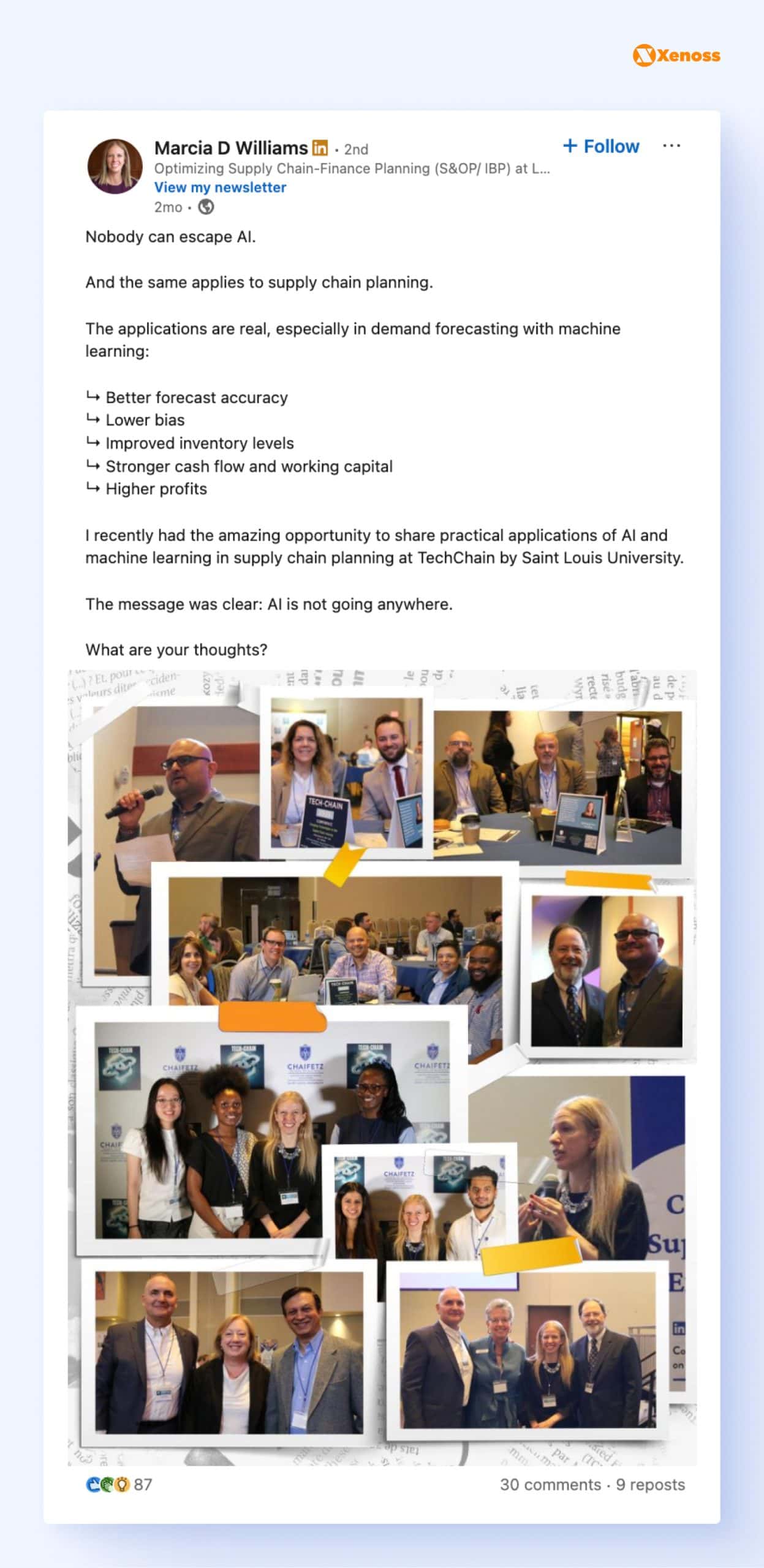
These tools combine historical sales, real-time signals, and ML models to predict demand shifts and optimize inventory. Compared to traditional statistical methods, predictive demand forecasting delivers long-term value, cutting waste and reducing operational costs by up to 30%.
How Danone improved its supply chain with demand forecasting
The company adopted advanced predictive analytics, integrating historical sales, promotions, media signals, and seasonality patterns into continuous demand forecasts. Previously, Danone relied on statistical averages that couldn’t incorporate real-time market data.
The new approach brought in real-time indicators and cross-functional inputs from supply chain, sales, marketing, and finance, creating forecasts that accounted for demand volatility, reduced forecast errors by 20%, and recovered 30% of previously lost sales.
Predictive analytics tools for demand forecasting in supply chain management
| - AI/ML demand forecasting - Probabilistic forecasts - Exception-based planning workflows. | PepsiCo deployed Blue Yonder planning capabilities (production planning in a supply chain context). | Strong planning UX, mature supply-chain suite | Enterprise implementation effort can be significant | |
| - Concurrent planning and rapid scenario analysis (“what-if”) - Demand planning application integrated with broader supply planning/execution. | Schneider Electric, Ford, Unilever | Excellent for high-volatility environments where teams need fast replanning across functions; strong scenario capability. | Typically better suited to larger enterprises; cost/implementation overhead can be non-trivial | |
| - ML/statistical forecasting - Collaborative demand planning - Integrates tightly with SAP landscapes and planning processes. | Blue Diamond Growers implemented supply chain planning solution based on SAP IBP) | Strong choice if you’re already SAP-heavy; good governance + integration for IBP/S&OP operating models. | Value depends on data quality and process maturity Adoption can feel heavy if you need lightweight forecasting only. | |
| - AI/ML forecasting and demand sensing - Collaborative planning on a unified “digital brain” data model with cross-functional workflows. | o9 states 160+ clients overall (not all demand-forecasting-only), and publishes anonymized demand planning case studies. | Strong for “one plan” alignment across demand/supply/finance; good for complex assortments and frequent business changes. | Customer logos and outcomes are often gated/anonymized; can be overkill if you only need statistical forecasting. | |
| - Sense/predict/shape demand; built-in ML - Connects demand insights with supply constraints and stakeholder inputs. | Oracle highlights customer stories for demand management (e.g., BISSELL discussing demand management and forecasting in Oracle programming). | Good fit if you want planning tightly integrated with Oracle cloud apps; ML embedded in planning workflows. | Public pricing is limited; the planning stack can be broad - scope control matters to avoid complexity creep. |
2. Supplier risk management
McKinsey classifies suppliers into three tiers based on visibility:
Predictive analytics improves visibility into deeper tiers, helping managers spot problems before they disrupt operations.
These tools continuously analyze supplier performance, delivery patterns, quality trends, and external risk signals to forecast where issues are likely to occur.
With proactive risk evaluation, supply chain teams can reduce late deliveries, quality failures, and supplier instability by adjusting orders or renegotiating terms before disruptions escalate.
How Pietro Agostini, an Italian industrial engineering company, tapped into predictive analytics to vet suppliers
During the COVID-19 pandemic, the Italian industrial engineering company built a quantitative supplier risk model to improve how it evaluated and monitored suppliers. Previously, evaluation was largely qualitative and didn’t allow engineers to anticipate disruptions or prioritize responses.
The team developed a quantitative-qualitative risk scoring methodology based on FMEA (Failure Mode and Effects Analysis) principles, assessing the probability, severity, and detectability of supplier risk factors.
The model generated a data-driven risk profile for each supplier and recommended prioritized actions for procurement teams.
Predictive analytics tools for supplier risk management
| - AI-driven supplier/disruption risk monitoring - Multi-tier (sub-tier) mapping - Continuous risk scoring across geopolitical, cyber, financial, operational signals - Scenario impact analysis. | Google, NASA, U.S. Navy, L3Harris (reported); also cited: U.S. DoD, Accenture, Freddie Mac. | Strong for network-level visibility and “who’s connected to whom” risk propagation (useful when a Tier-2 event becomes your Tier-1 problem). | Enterprise onboarding depends heavily on supplier/master-data quality and mapping completeness | |
| Supplier risk monitoring + event intelligence; multi-tier supplier mapping; disruption alerts; supplier outreach/workflows; resilience analytics for mitigation planning. | IBM, General Motors, Amgen, Western Digital (examples listed in customer references). | Mature disruption management focus (alerts → workflows → mitigation) with strong “operationalization” for supply chain teams. | Breadth across risk types can vary depending on data feeds and configuration. | |
| Predictive risk intelligence for supply chains (weather, port/transport disruption, geopolitical risk, sub-tier supplier risk); early-warning alerts; risk scoring; integration into procurement/logistics/BCC tooling. | Google, Schneider Electric, Jaguar Land Rover, Vestas, HealthTrust Purchasing Group. | Good fit when you want predictive “risk before it hits” for both supplier and logistics disruption patterns (not just static supplier profiles). | Best value typically requires tight integration into planning/exception workflows | |
| AI-based risk detection from external signals; supplier monitoring for ESG/compliance + operational risk; real-time alerts; supplier engagement workflows; focus on regulatory readiness and sustainability risk. | Audi, Porsche, Volkswagen, Yanfeng | Particularly strong where supplier risk is tied to ESG/compliance + reputational exposure and you need continuous monitoring at scale. | Depending on use case category, you may still need complementary tools for deep financial/OTIF performance analytics and internal ERP-based supplier KPIs. | |
| AI-supported supply chain risk detection; supplier risk scoring; sub-tier visibility; compliance + transparency capabilities; alerting and action planning. | Bosch, Deutsche Telekom, Siemens | Strong for teams that want supplier risk assessment integrated with broader operational risk / ESG / compliance programs under one umbrella. | As a broad risk platform, scope can expand quickly; value realization depends on disciplined use-case definition (risk types, thresholds, response playbooks). |
3. Freight management
Poor route planning, last-minute shipping premiums, detention fees, and inefficient routing increase fuel use and drive up logistics costs. Detention alone affects about 40% of loads, costing teams $50–$100 per hour on average.
AI and predictive analytics are helping supply chain teams address these bottlenecks, cutting transportation costs by up to 30% and reducing disruptions by 15%.
These tools operationalize real-time and historical data (weather, traffic patterns, port conditions) to dynamically adjust routes and avoid congestion.
How predictive analytics powers reliable freight management at UPS
The company’s ORION system (On-Road Integrated Optimization and Navigation) uses predictive analytics to recommend the most efficient stop sequences and route choices for drivers.
The model dynamically adjusts based on operational constraints: time windows, pickup/delivery patterns, and facility realities like loading dock availability. After a successful pilot, UPS expanded ORION across tens of thousands of routes and paired it with purpose-built navigation.
Tools that use predictive analytics for freight management
| Descartes Systems | Advanced route optimization, real-time traffic/conditions, multi-stop sequencing, integration with TMS/warehouse systems. Uses predictive logic to anticipate delays and optimize routes. | Large logistics and retail fleets worldwide (Global supply chain deployments; widely used in manufacturing & distribution). | - Very mature enterprise routing and freight optimization with deep integration - Scalable for global operations. | - Often more expensive than standalone tools - Complexity can require dedicated implementation resources. |
| FarEye | Predictive delivery and route optimization, exception/ETA forecasting, analytics dashboards, real-time tracking. | Companies in retail, e-commerce and CPG (e.g., global brands adopting intelligent delivery systems). | - Focus on last-mile performance and predictive delivery insights - Strong real-time exception handling. | Best suited for last-mile/parcel contexts: may need complementing for full freight or multimodal planning. |
| Route4Me | Rapid multi-stop route optimization with predictive suggestion of efficient sequencing and dynamic rerouting. | Small/medium fleets, field service organizations, delivery businesses. | - Very easy to implement - Cost-effective and flexible for mid-size operations. | Less robust predictive analytics than enterprise TMS; best for simpler delivery networks. |
| Verizon Connect | Predictive routing with telematics integration, real-time route completion forecasting, vehicle performance analytics. | Enterprise fleets (transport, field services, logistics operators). | - Strong telematics and route optimization for large fleets - Real-time operational insights. | Can be pricey; advanced features may require targeted configuration. |
| Samsara | AI-enabled route planning and traffic prediction paired with IoT sensors, live tracking and predictive ETA/exception alerts. | Large logistics/transport customers and enterprise fleets (manufacturing, distribution). | Combines route prediction with rich sensor data for operational visibility; strong mobile/driver app. | Analytics depth depends on data quality and sensor deployment maturity. |
4. Simulating scenarios with predictive digital twins
Embedding predictive analytics into digital twins gives planners a living, data-driven simulation of their entire network that anticipates disruptions, tests “what-if” scenarios, and evaluates outcomes before they occur in the real world.
As Paul Narayanan, Chief Transformation and Digital Officer at KENCO, explains:
“Digital twin technology is transforming the supply chain and logistics industry by creating virtual replicas of physical operations that mirror real-time activities, equipment, and workflows. The result is optimized processes and enhanced efficiency.”
Organizations leading in predictive simulations report significant gains: up to 20% improvement in on-time delivery, 10% reduction in labor costs, and 5% uplift in revenue. Access to live data and predictive modeling helps these teams fine-tune distribution center utilization and fulfillment strategies.
How combining digital twins and predictive analytics helped Aliaxis improve supply chain planning
The global piping and fluid-management manufacturer, operating in 40+ countries, built a digital twin of its European network to run simulations and “what-if” analyses before making real-world decisions.
Teams use the model to test alternative network configurations (e.g., distribution-site consolidation), transportation setups, and make-or-buy options, predicting downstream impacts on cost, stock levels, and service outcomes.
After rollout, Aliaxis reported 9% potential cost reduction in total logistics from network and transportation redesign scenarios. Understanding how consolidation affects stock helped reduce inventory, while the same capability compressed decision cycles from months to days.
Tools that help build digital twins with predictive analytics for simulating operations
| - Supply chain digital twin simulation - Real-time data integration - Bottleneck prediction - Scenario analysis - Risk and transportation planning | Used by large manufacturers and supply chain planners (e.g., Infineon, Amazon, GSK in simulation case contexts via AnyLogic/anyLogistix. | Strong supply chain focus, rich scenario testing & risk analytics; integrates with SCM/ERP for predictive insights. | Strong supply chain focus, rich scenario testing & risk analytics; integrates with SCM/ERP for predictive insights. | |
| - General-purpose simulation with digital twin capability supports agent-based, discrete event, system dynamics - Integrates real data for predictive simulation. | Used by consultancies and enterprises for supply chain forecasting (e.g., exercise equipment brand order-to-delivery twin). | Very flexible simulation paradigms; industry use cases across supply chain, logistics, and manufacturing. | Very flexible simulation paradigms; industry use cases across supply chain, logistics, and manufacturing. | |
| RELEX Digital Twin | Integrated digital twin for supply chain forecasting, inventory optimization, scenario planning, demand/replenishment simulation. | Vita Coco built a digital twin for global supply chain optimization. | Deep supply chain planning integration; built-in scenario & inventory predictive modeling. | Deep supply chain planning integration; built-in scenario and inventory predictive modeling. |
| Logistics/supply chain mapping and virtual experimentation with predictive scenario simulation; integrates operational data for planning. | Shared across large industrial/logistics sectors via Siemens digital logistics clients. | Strong integration in manufacturing/industrial ecosystems, combined with IoT data streams. | Strong integration in manufacturing/industrial ecosystems, combined with IoT data streams. | |
| Digital twin concepts embedded in SAP Integrated Business Planning for simulation of network, demand/supply behaviors, and what-if scenarios. | SAP's large-enterprise customer base (retail, manufacturing). | Built into existing SAP landscape; strong governance for planning and predictive simulation. | Built into existing SAP landscape; strong governance for planning & predictive simulation. |
Timeline and cost considerations for predictive analytics adoption in supply chain management
Phase 1: Use-case selection
Project timeline: 0-2 months since kick-off
Steps to take: Quantify the cost and impact of supply chain decisions by translating planning outcomes into clear financial consequences using existing data.
For each decision you want to improve: how many SKUs to order, when to expedite, which supplier to choose, start by measuring historical error: how often the decision went wrong and what it caused (excess inventory, stockouts, late deliveries, premium freight).
Then attach unit costs: carrying cost per unit per month, lost margin per stockout, expediting cost per shipment, penalty fees, or wasted labor hours.
To estimate the impact of predictive analytics, model a conservative improvement (e.g., 10–15% reduction in forecast error or fewer late supplier deliveries) and convert that delta into annualized savings or revenue protected.
Cost considerations: Primary costs come from internal time: supply chain leaders, planners, finance, and IT aligning on decisions, data availability, and success metrics, with minimal external spend beyond light advisory support if needed. It’s best to avoid software purchases, large data work, or model development at this stage.
When the phase is successful: Phase 1 is successful if you leave with a clear business case, defined owners, and quantified ROI assumptions, without committing capital prematurely.
Phase 2: Building the data foundation
Project timeline: 2-5 months since kick-off
Steps to take: After selecting a high-yield use case, prepare the data that prediction models will use.
Data engineers pull the required data (order history, inventory positions, lead times, shipment events, etc.) and run basic validation, reconciling mismatches across systems, removing noise (outliers, duplicates, missing periods), and reality-checking against event logs.
To operationalize this data, the team sets up a repeatable pipeline with clear ownership and refresh frequency, ensuring inputs can reliably feed pilots and future scaling without manual intervention.
Cost considerations: Most spending comes from data engineering time to extract, reconcile, and reshape data. Infrastructure costs include cloud storage and compute for repeatable pipelines, plus limited tooling for integration or data quality checks.
When the phase is successful: Phase 2 is complete when you can reliably produce a decision-ready dataset that is updated on schedule, requires no manual work, and accurately reflects business operations.
Phase 3: Modeling and pilot execution
Project timeline: 5-10 months since kick-off
Steps to take: Once the team has validated high-quality data, these inputs are transformed into predictions that leaders can trust and test in the real world.
At this stage, machine learning engineers build or configure predictive models for the chosen use case, train them on historical data, and benchmark performance against business-relevant metrics.
The model is then deployed on a small pilot, limited to a specific region, product set, or lane. Before scaling the model, compare predictions against current planning methods, planner actions, and measure their impact on cost, service, or risk.
Cost considerations: Main expenses include data science and analytics engineering time, compute resources for training and testing, and (if buying rather than building) software licensing for forecasting or ML platforms.
Costs can rise quickly as pilot scope expands, so limit this phase to a clearly defined segment and avoid over-optimizing before business impact is proven.
When the phase is successful: the pilot stage is complete when predictive models consistently outperform current planning methods on real data and demonstrate measurable impact in a live pilot without increasing planner workload.
Phase 4: Scaling the pilot to deliver organization-wide value
Project timeline: 11-15 months since kick-off
Key steps: While small-scale pilots should generate ROI within months of deployment, the true operational impact emerges when model outputs are embedded into core planning and execution systems (ERP, S&OP, replenishment, TMS).
Once predictive analytics is part of the supply chain stack, it influences parameters like reorder points, production quantities, and routing priorities, creating a measurable impact across the flow.
To ensure standardized deployment, define clear automated and semi-automated decision rules that effectively allocate planner time. Make sure to establish governance, monitoring, and KPIs to ensure the system consistently supports new product lines, regions, and use cases.
Cost considerations: At this stage, the largest expenses are tied to connecting predictive models to core systems, building workflows and decision rules, and training teams to trust and act on outputs.
Platform, compute, and model-maintenance costs become recurring.
This phase also delivers the highest ROI because spend is tied directly to operational adoption and scaled impact, not experimentation.
When the phase is successful: a predictive analytics implementation is a success when insights are automatically embedded into daily planning and execution, drive consistent decisions at scale, and require little to no manual oversight.
Bottom line
The companies in this article didn’t transform overnight. They picked one problem, proved predictive analytics could solve it, and scaled from there.
Which supply chain decision is costing you the most when it’s wrong? That’s where to start.