

80% of Fortune 500 companies are running active AI agents, most of them built with low-code tools by non-technical employees. Only 47% of those organizations have implemented security controls for generative AI. And 29% of employees admit to using unsanctioned agents for work tasks. AI adoption inside enterprises is outrunning governance by a wide margin.
Shadow AI is the enterprise version of a problem every household knows: somebody brought something home without asking. In this case, employees are adopting AI tools, building AI agents, and connecting them to company data without IT or security oversight.
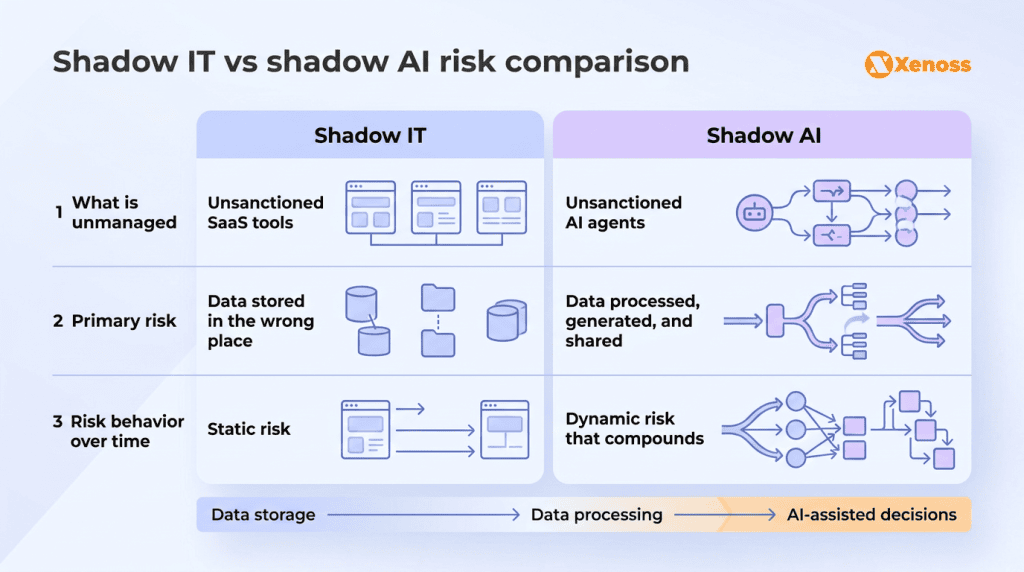
The difference between shadow AI and the old shadow IT problem (employees using Dropbox instead of SharePoint) is that AI agents don’t just store data. They process it, make decisions on it, chain actions across multiple systems, and generate outputs at machine speed. An unsanctioned Dropbox folder is a compliance headache. An unsanctioned AI agent with inherited database permissions is a breach waiting to happen.
This article covers what shadow AI looks like in practice (it has evolved well beyond ChatGPT), what it costs, how to detect it, and how to build governance that enables AI adoption without losing control.
Summary
- Shadow AI adds $670,000 to the average data breach cost, according to IBM’s Cost of a Data Breach report. One in five organizations experienced a breach linked to unsanctioned AI use.
- 80% of Fortune 500 companies now deploy active AI agents built with low-code/no-code tools, per Microsoft’s Cyber Pulse report. Only 47% have implemented GenAI security controls.
- 29% of employees use unsanctioned AI agents for work tasks. Microsoft calls the resulting risk “double agents”: AI systems that inherit enterprise permissions but operate outside governance.
- Detection requires active discovery, not just policy enforcement. Network traffic analysis, API call monitoring, browser extension audits, and application inventory scans are all needed to surface ungoverned agents.
What is shadow AI?
IBM defines it as employees downloading or using unapproved internet-based AI tools, and their research found that 63% of breached organizations either lack an AI governance policy entirely or are still developing one. Only 37% have policies in place to manage AI or detect shadow AI usage.
Shadow AI is the natural successor to shadow IT, but the risks compound in ways shadow IT never did. When an employee used an unsanctioned SaaS tool, the worst case was usually data stored in the wrong place.
When an employee deploys an AI agent that connects to the CRM, reads customer records, and generates automated outreach, the worst case includes data exfiltration, compliance violations, hallucinated outputs sent to customers, and an audit trail that doesn’t exist. The scale and speed of AI operations turn a governance gap into an operational risk.
The “double agents” problem
The concept of double agents is straightforward. An AI agent deployed by an employee or team inherits the permissions of the person who created it: database access, API credentials, file system permissions, email privileges.
If that agent is then manipulated through prompt injection, memory poisoning, or simply through overly broad instructions, it becomes an adversary operating from inside the perimeter, with legitimate credentials.
Microsoft’s AI Red Team documented an attack vector called Memory Poisoning (MITRE ATLAS AML.T0080), where attackers inject persistent, unauthorized instructions into an agent’s memory through deceptive interface elements. The agent then follows those instructions using the permissions of the employee who deployed it.
Shadow AI in 2026: From chatbots to autonomous agents
The first wave of shadow AI was employees pasting company data into ChatGPT. That problem is well understood and mostly addressed through DLP controls and acceptable use policies. The current wave is more complex and harder to detect.
Personal AI accounts used for work. Employees subscribe to Claude, Gemini, or ChatGPT Plus on personal accounts and use them to draft emails, analyze spreadsheets, summarize meeting notes, and generate code. The data flows through personal accounts that corporate DLP cannot monitor.
AI agents with inherited permissions. Low-code platforms like Microsoft Copilot Studio, Power Automate, and third-party tools let non-technical employees build agents in minutes. These agents connect to SharePoint, Salesforce, Teams, and internal databases using the creator’s credentials. Microsoft’s telemetry shows that agent building is no longer limited to technical roles. Employees across marketing, finance, and operations are creating agents that access sensitive systems.
MCP-connected tools operating without oversight. The Model Context Protocol makes it trivially easy to connect AI agents to enterprise tools. MCP gateways exist to govern this, but many organizations don’t have one. Employees connect coding assistants, research agents, and workflow automators to internal APIs using MCP, creating data pathways that security teams cannot see.
Browser extensions and embedded AI. AI-powered browser extensions for summarizing, translating, and writing are installed without IT approval. These extensions can read page content, which means they see whatever the employee sees, including internal dashboards, financial reports, and customer data.
Shadow AI risks and what they cost enterprises
Organizations with high levels of shadow AI faced $670,000 in additional breach costs compared to those with low or no shadow AI. That made shadow AI one of the top three costliest breach factors, displacing security skills shortages from previous years.
20% of studied organizations experienced a breach linked to shadow AI. One in five.
97% of organizations that had an AI-related breach lacked proper AI access controls. Not sophisticated controls. Basic access controls.
Breach lifecycle was 247 days for shadow AI incidents, versus the global average of 241 days. The extra week exists because shadow AI breaches are harder to detect when the tool that caused them isn’t in your inventory.
65% of shadow AI breaches compromised customer PII (compared to 53% for breaches overall), and 40% involved intellectual property theft.
Beyond direct breach costs, shadow AI creates compliance exposure. Organizations subject to GDPR, HIPAA, or the EU AI Act face regulatory penalties when data is processed through tools that don’t meet compliance requirements. An employee uploading patient records to an ungoverned AI tool is a HIPAA violation regardless of whether a breach occurs.
Why employees turn to shadow AI
Before jumping to detection and enforcement, it helps to understand why people adopt unsanctioned AI in the first place.
Approved tools are too slow or limited. Enterprise AI deployments have a success problem. Sanctioned tools often go through months of procurement, security review, and configuration. By the time they launch, employees have already found faster alternatives on their own. When the approved tool requires five steps to do what ChatGPT does in one, people take the shortcut.
Productivity pressure outpaces policy. Teams are under pressure to deliver more with the same resources. AI tools offer immediate productivity gains. When the organization hasn’t provided clear guidance on what’s allowed, employees make their own decisions. And they usually default to whatever works.
Governance creates gray areas. Many organizations have AI usage policies that say things like “use approved tools for sensitive data.” But the definition of “sensitive” is unclear, the list of “approved tools” is incomplete, and nobody audits compliance. These policies create the appearance of governance without the substance of it.
How to detect shadow AI in your organization
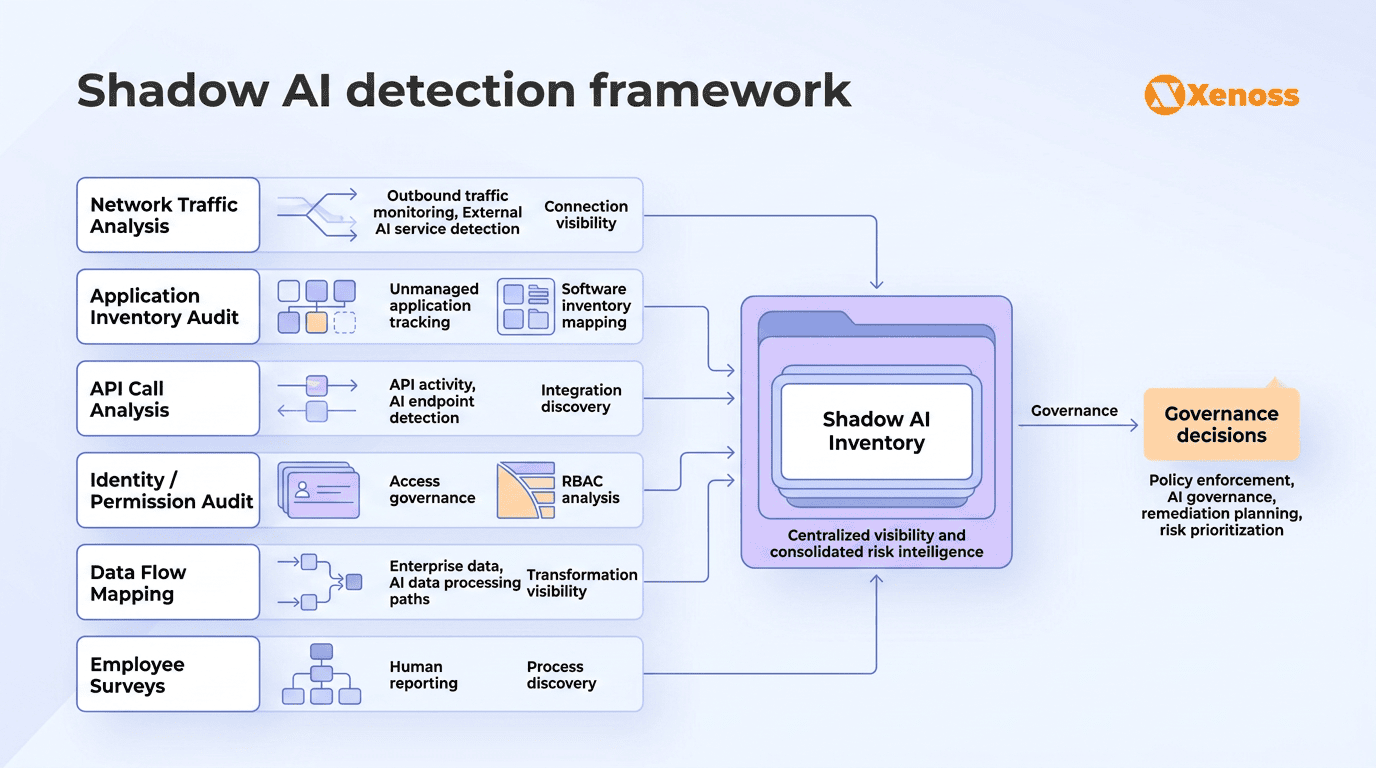
Detection is the prerequisite for governance. You cannot govern what you cannot see. Six practices, used together, surface the majority of shadow AI activity.
- Network traffic analysis. Monitor DNS queries and outbound traffic for connections to known AI endpoints (api.openai.com, api.anthropic.com, generativelanguage.googleapis.com, and model-hosting platforms). Cloudflare’s Shadow MCP detection approach uses DLP profiles for exactly this purpose.
- Application inventory audits. Scan endpoints for installed AI applications, browser extensions, and IDE plugins. Many shadow AI tools run as browser extensions that corporate endpoint management tools can inventory if configured to look for them.
- API call analysis. Review API gateway logs for unexpected outbound API calls to AI service providers. If your SIEM logs show authenticated API calls to inference endpoints that your engineering team did not configure, those are shadow deployments.
- Identity and permission audits. Review OAuth tokens, service principals, and API keys associated with AI agent identities. Look for agents created through low-code platforms (Power Automate, Copilot Studio) that were not registered through a formal approval process.
- Data flow mapping. Trace where sensitive data is moving. If customer PII or financial data is being sent to endpoints not in your approved vendor registry, you have shadow AI. The average enterprise experiences 223 data policy violations per month related to AI usage.
- Employee surveys. Ask directly. Anonymous surveys about AI tool usage often reveal shadow AI activity that technical monitoring misses, especially personal AI subscriptions used on personal devices for work tasks. The results also identify unmet needs that governance policies should address.
AI agent governance: A framework for shadow AI prevention
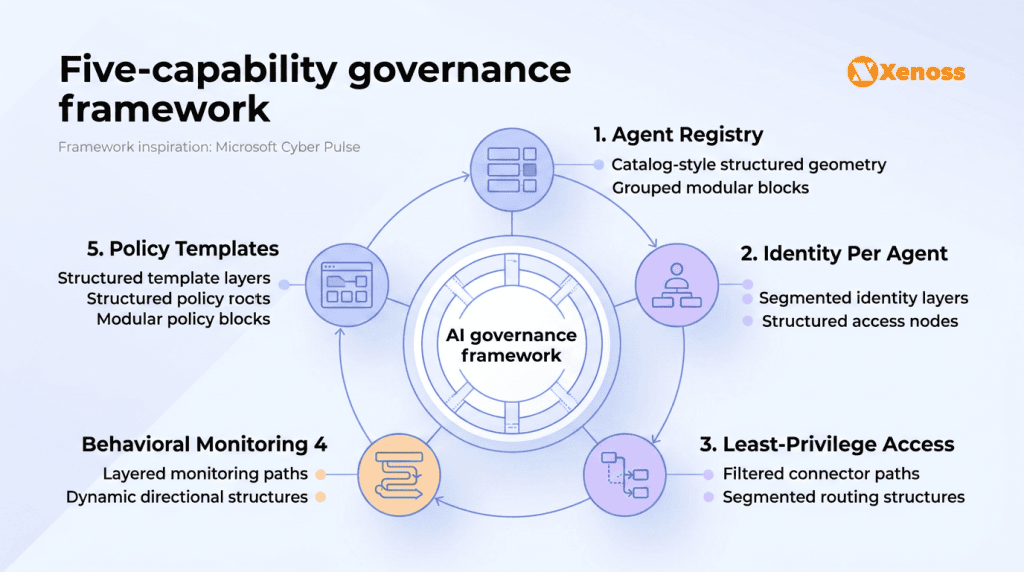
Microsoft’s Cyber Pulse report outlines five governance capabilities that enterprise security teams need. The framework aligns with what Xenoss engineers see across Fortune 500 AI deployments: organizations that implement these capabilities early build enterprise AI security into the foundation rather than bolting it on after ungoverned agents surface in production.
Agent registry. A centralized inventory of every AI agent in the organization: sanctioned, third-party, and shadow. The registry must support active discovery, not just manual registration. Individual teams deploy agents without central visibility. The registry needs to find what’s already running, not just catalog what gets formally submitted.
Identity per agent. Every agent gets its own identity in the identity provider, with permissions scoped to its specific function. No shared credentials, no inherited user permissions. If an agent needs to read from a CRM, it gets a service principal with read-only CRM access, not the deploying user’s full permission set.
Least-privilege access control. Agents receive only the permissions required for their specific task. Write permissions are granted only when necessary and require explicit approval. MCP gateways with tool-level authorization enforce this at the infrastructure level.
Behavioral monitoring. Real-time observability into what agents are doing: which tools they call, what data they access, what outputs they generate, and whether their behavior changes over time. Anomalies (an agent suddenly accessing databases it never touched before, or generating outputs at unusual hours) trigger alerts.
Policy templates. Standard security configurations applied to every new agent from day one. Rather than reviewing each agent individually, define tiers (low-risk read-only, medium-risk read-write, high-risk customer-facing) with pre-built policy templates that enforce appropriate controls automatically.
Shadow AI in banking, healthcare, and manufacturing
Shadow AI risk varies by industry because the data involved varies by regulation.
Banking and financial services. AI agents processing customer financial data, generating investment recommendations, or automating compliance reports without governance create exposure under the SEC’s AI risk management guidance, the CFPB’s algorithmic lending rules, and the EU AI Act’s high-risk classification for credit scoring. A shadow agent that generates client-facing analysis without compliance review is a regulatory violation.
Healthcare and pharma. HIPAA requires covered entities to maintain an inventory of all systems that process protected health information. An unsanctioned AI agent summarizing patient records or generating clinical notes creates an unaudited PHI processing pathway. In pharma, shadow AI analyzing clinical trial data outside validated environments can compromise data integrity requirements under FDA 21 CFR Part 11.
Manufacturing and industrial. AI agents connected to SCADA systems or industrial control networks without security review create operational safety risks beyond data privacy. An agent that modifies production parameters, even to optimize efficiency, without safety validation could cause equipment damage, product quality failures, or worker safety incidents.
Bottom line
Shadow AI is a current risk. IBM documents $670,000 in additional breach costs. Microsoft confirms 80% of Fortune 500 companies run active AI agents while only 47% have security controls. 29% of employees are already using unsanctioned agents for work. The governance gap is real, measured, and expensive.
The response should not be blanket bans. Employees turn to shadow AI because approved tools are too slow, too limited, or don’t exist. The organizations that manage this best provide sanctioned AI capabilities that meet employee needs, implement active detection to surface ungoverned agents, and build governance frameworks that enable AI adoption at speed without losing visibility, access control, or audit coverage.
For enterprises in regulated industries (banking, healthcare, manufacturing), shadow AI governance is not a security initiative alone. It is a compliance, operational, and reputational initiative that requires coordination between CISO, CIO, compliance, and business leadership. The agents are already running. The question is whether you know about them.
FAQ
How much does shadow AI cost?
According to IBM’s Cost of a Data Breach report, shadow AI adds an average of $670,000 to breach costs. Organizations with high levels of shadow AI experienced total breach costs of approximately $4.63 million, which is 16% above the global average. Shadow AI breaches also take longer to detect (247 days vs. 241-day average) and disproportionately compromise customer PII (65% of cases) and intellectual property (40% of cases). Among organizations that experienced AI-related breaches, 97% lacked basic access controls for AI systems.
How do you detect shadow AI?
Shadow AI detection requires six complementary approaches: network traffic analysis (monitoring outbound connections to AI service endpoints), application inventory audits (scanning for installed AI tools and browser extensions), API call analysis (reviewing logs for unexpected calls to inference APIs), identity and permission audits (checking for unregistered agents created through low-code platforms), data flow mapping (tracing sensitive data to unauthorized endpoints), and employee surveys (asking directly about AI tool usage). No single method catches everything. Effective detection combines technical monitoring with human disclosure.
How is shadow AI different from shadow IT?
Shadow IT typically involves employees using unsanctioned SaaS tools or cloud storage, where the primary risk is data stored in the wrong place. Shadow AI compounds the risk because AI agents process data, make decisions, chain actions across systems, and generate outputs at machine speed. An unsanctioned file-sharing tool creates a data residency problem. An unsanctioned AI agent with inherited database permissions creates a data exfiltration, compliance violation, and operational disruption problem simultaneously. Microsoft’s Cyber Pulse report describes the most concerning evolution as “double agents”: AI agents that inherit enterprise permissions and can be manipulated by adversaries to operate from inside the security perimeter.