
Data integration has become one of the most persistent challenges in enterprise IT. 95% of IT leaders currently struggle to integrate data across systems. 81% say data silos are hindering digital transformation, and only 29% of applications are typically connected within organizations.
The average number of apps deployed per company has now topped 100, growing 9% year over year.
Meanwhile, 62% of IT leaders say their data systems aren’t configured to fully leverage AI. This gap holds organizations back from fully operationalizing machine learning and generative AI.
The result is a growing demand for platforms that reliably unify data across an increasingly fragmented technology landscape.
In this post, we’ll break down what data integration platforms do, compare leading solutions, and outline the key criteria for choosing the right approach for your organization.
Why do you need a data integration platform?
Enterprise data lives everywhere, scattered across SaaS tools, cloud warehouses, legacy systems, and partner feeds. Stitching it together manually is slow, fragile, and a drain on engineering resources.
Data integration platforms solve this problem by handling ingestion, transformation, and sync in one place. They support engineers with reliable, near-real-time data flows and help teams focus on analytics and AI rather than firefighting broken pipelines.
Must-have features for data integration platforms
Support for both batch and streaming data processing
Why it is important: Modern data workloads aren’t one-size-fits-all. Some use cases demand real-time data movement; others are better served by scheduled batch jobs.
A data integration platform that supports both streaming and batch processing lets teams balance latency, cost, and reliability without juggling separate tools or architectures.
Questions to ask vendors
Question: Does the platform natively support both streaming and batch pipelines within a single orchestration layer?
What to look for in the answer: Strong platforms offer first-class support for both modes, with shared monitoring, governance, and the flexibility to switch or combine processing types without rebuilding pipelines.
Question: How does the platform handle late-arriving, out-of-order, or replayed events in streaming workflows?
What to look for in the answer: Look for built-in mechanisms for event-time processing, deduplication, and replay without data loss or manual intervention.
Data governance and lineage tools
Why this is important: As data volumes and stakeholders grow, teams need clear visibility into where data originates, how it’s transformed, and who can access it.
Strong governance and lineage capabilities reduce compliance risk, build trust in analytics, and make it far easier to diagnose issues when pipelines break or upstream data changes.
Without these frameworks, even well-built pipelines become operationally fragile.
Questions to ask vendors
Question: How are access controls, masking, and compliance policies enforced across integrated data?
What to look for in the answer: Look for centralized policy management that applies consistently across ingestion, transformation, and delivery.
Question: Can lineage and governance metadata integrate with existing catalogs or security tools?
What to look for in the answer: Check for native integrations or open APIs that allow governance data to flow into enterprise catalogs, IAM systems, and audit tools.
A connector library (with the ability to build custom connectors)
Most organizations run fragmented stacks, with data spread across SaaS applications, databases, APIs, and internal systems.
A broad connector library accelerates integration, and the ability to build custom integrations gives teams the flexibility to integrate internal tools, legacy systems, or proprietary data sources.
Questions to ask vendors
Question: How extensive and actively maintained is the native connector library?
What to look for in the answer: Ensure the library covers modern SaaS applications, databases, and cloud platforms, with frequent updates and clear SLAs for connector reliability.
Question: Can teams build, deploy, and maintain custom connectors without vendor involvement?
What to look for in the answer: Look for a documented SDK or framework that treats authentication, schema evolution, and error handling as first-class features. Custom and native connectors should share the same monitoring, alerting, versioning, and security controls.
Data catalog and metadata management
Why it is important: As data ecosystems scale, teams need a shared understanding of what data exists, what it means, and how it should be used.
Data catalogs and metadata management help turn raw tables and fields into discoverable assets and reduce confusion and duplicated effort.
Without this layer, valuable data often goes underutilized or is misinterpreted.
Questions to ask vendors
Question: Is metadata captured automatically across ingestion, transformation, and delivery?
What to look for in the answer: Ensure the vendor offers automated harvesting of technical and business metadata without requiring manual tagging.
Question: Does the catalog support business-friendly documentation and ownership models?
What to look for in the answer: Look for support for descriptions, glossary terms, owners, and stewardship workflows that are accessible to non-technical users.
Top data integration platforms
1. Fivetran
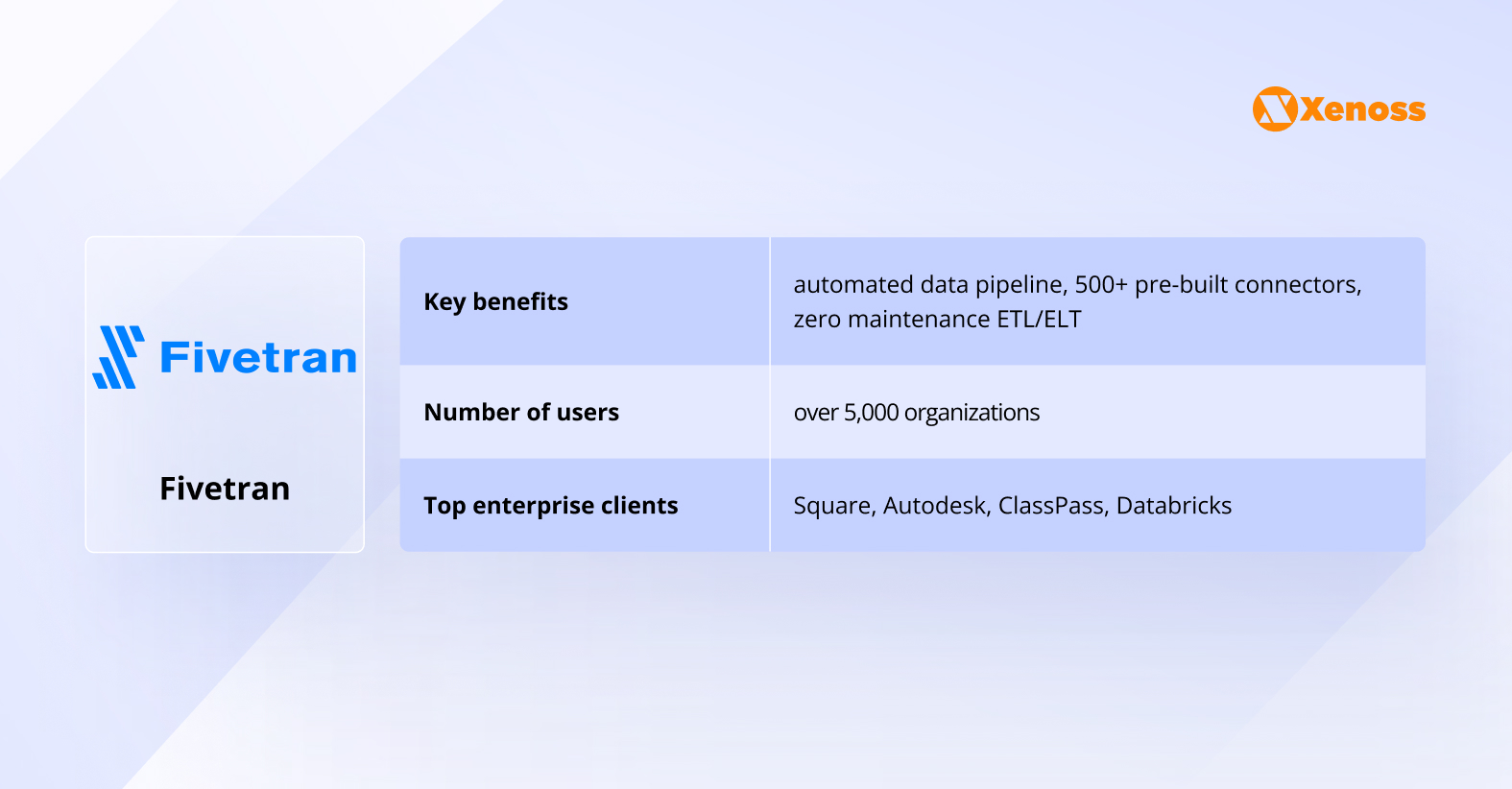
Fivetran is a fully managed, cloud-native data integration platform built around automated, reliable data ingestion from an extensive library of prebuilt connectors.
It prioritizes low-maintenance pipelines and consistent schema management over complex, custom transformations and is helpful for teams that want fast time to value with minimal operational overhead.
Why teams choose Fivetran
Fivetran stands out for teams that want data pipelines to simply work with minimal ongoing effort.
The platform manages infrastructure, scaling, and schema changes, so engineers spend far less time maintaining connectors or fixing broken syncs.
Fivetran’s extensive, production-ready connector library also makes it easy to centralize data from common SaaS tools, databases, and cloud platforms quickly.
For analytics-driven teams that prioritize speed, stability, and low operational overhead over deep customization, Fivetran significantly shortens time to insight and reduces the day-to-day burden of running data integration.
Fivetran is quite pricey, but it will handle all data replication from, for example, Salesforce to whatever warehouse you use. To answer your question, you can configure it to handle updates and deletes depending on your use-case.
A data engineer on the benefits of using Fivetran for data integration
Challenges teams face with Fivetran
Fivetran may feel limiting to teams that need granular control over extraction, transformation, or optimization due to the limited customization of its pipelines.
While the platform reduces operational burden through abstraction, complex business logic often requires pairing Fivetran with additional transformation or orchestration tools.
Its consumption-based pricing becomes expensive at scale, particularly for high-volume or high-frequency sources, making cost predictability a concern as data workloads grow.
I really think Fivetran was supposed to be a tool to use when you didn’t have any data engineers. It feels like it’s now supporting use cases far larger than it was really meant to support.
A Reddit comment highlights Fivetran’s limited scalability
Fivetran pricing model
Fivetran uses a usage-based pricing model centered on Monthly Active Rows (MAR), the unique rows inserted, updated, or deleted in your destination each calendar month after the initial sync. Infrastructure costs scale with activity and volume, with each connection metered separately.
A base minimum applies for low-usage connections (for example, $5 for connections generating up to 1 million MAR on paid plans), and unit costs per million rows decline as volume increases. Note that following the 2026 pricing update, billing is applied at the connection level, so total spend grows significantly as the number of connectors increases.
| Free | Starter tier for exploration or very low data volumes | Up to 500,000 MAR/month and 5,000 model runs at no cost |
| Standard | Most common plan for growing teams | Approximately $500 per million MAR; includes broad connector library, 15-minute syncs, unlimited users. |
| Enterprise | For larger teams needing faster syncs and advanced features | Around $667 per million MAR with 1-minute syncs, enhanced security, and enterprise DB connectors. |
| Business Critical | Highest-tier plan for regulated environments | Roughly $1,067 per million MAR, plus advanced compliance/security controls. |
| Connector base charge | Paid plan minimum monthly cost for low usage | $5 minimum per connection generating between 1–1 million MAR per month.) |
2. Airbyte
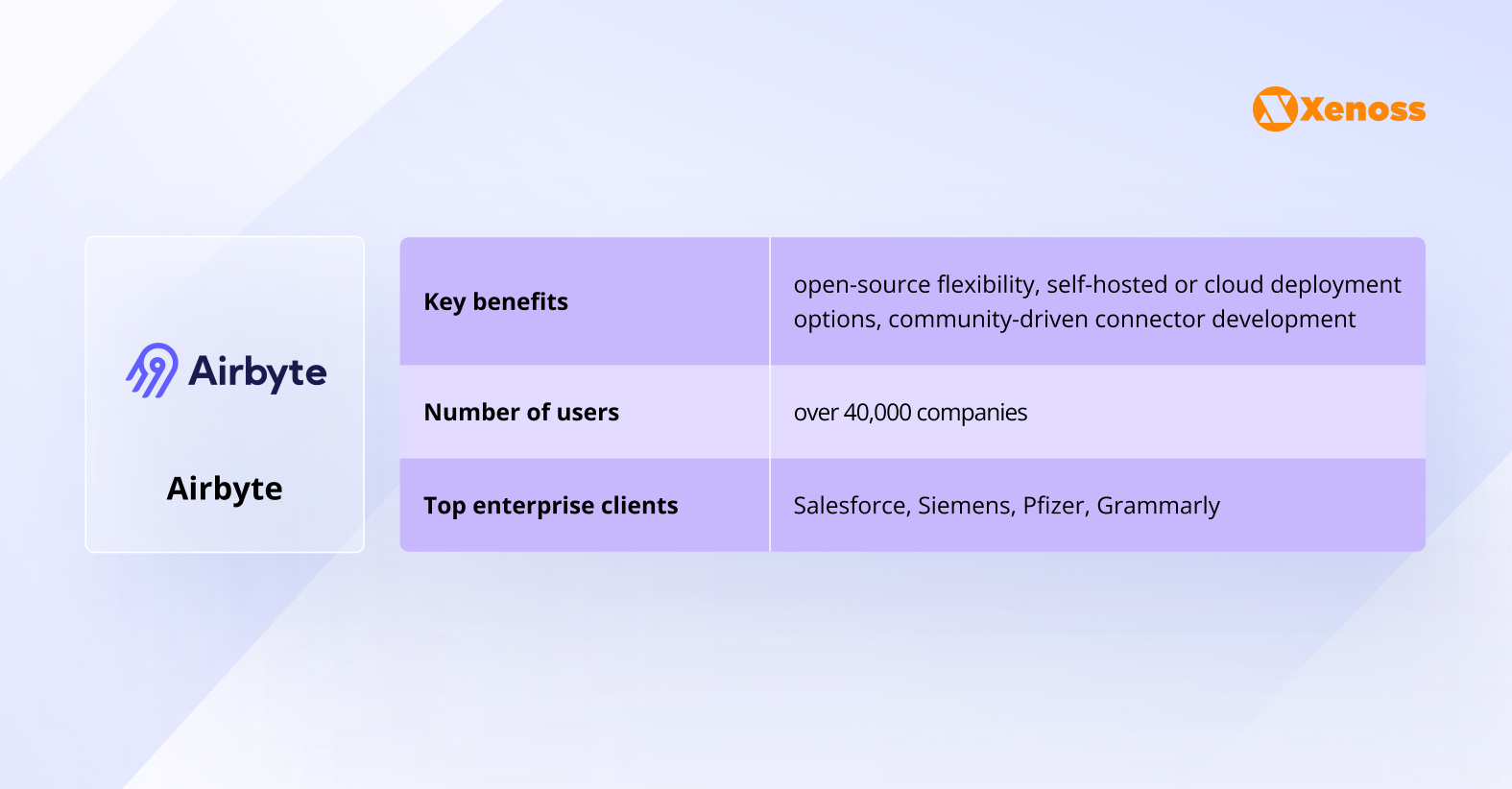
Airbyte is an open-source data integration platform that gives teams extensive control and transparency over how data pipelines are built, customized, and operated.
It’s well-suited for engineering-led organizations that need the flexibility to create custom connectors, manage transformations closely, and avoid vendor lock-in while scaling ingestion across diverse sources.
Why teams choose Airbyte
Airbyte works well for teams dealing with non-standard data sources or fast-changing APIs who can’t wait for a vendor to ship new connectors.
Its connector framework makes it practical to extend or modify integrations in-house, so that teams can ingest data from internal tools, SaaS products, or partner systems.
Because pricing isn’t tied to per-row usage, Airbyte offers more predictable cost control as volumes scale, so it is a solid choice for organizations expecting high throughput and willing to trade operational simplicity for flexibility and ownership.
Airbyte is an open-source data movement platform and one of the fastest growing ETL solutions because of its big community. Cheaper than Fivetran and a good alternative. I like their new AI-assisted connector builder feature.
A data engineer explains the benefits of Airbyte
Challenges teams face with Airbyte
Airbyte is challenging for teams not prepared to operate and maintain data infrastructure themselves because scaling and monitoring integrations built on the platform require hands-on engineering effort.
Connector quality and stability vary, particularly for community-maintained integrations, so teams may need to allocate time to debugging sync failures or handling schema changes.
For organizations that prioritize low operational overhead and guaranteed SLAs over flexibility and control, Airbyte may not be the best fit.
Airbyte pricing model
Airbyte offers a flexible pricing model ranging from free open-source to cloud-hosted and capacity-based managed plans.
For self-hosted deployments, there’s no license cost – organizations only pay for their own infrastructure.
Airbyte Cloud starts with a volume- and credit-based model: a low monthly minimum (around $10, including initial credits) covers basic usage, with additional credits consumed based on data volume (approximately $15 per million rows or $10 per GB).
Larger teams can opt for capacity-based pricing using “Data Workers,” a compute-oriented metric that decouples billing from raw data volume for more predictable costs.
Enterprise customers have access to custom agreements that include SLAs and advanced governance features. This range of options lets teams choose between simple pay-as-you-go billing and predictable capacity-based plans as their needs evolve.
| Open Source (self-hosted) | Free | $0 license cost Infrastructure and maintenance borne by the team | Teams with DevOps capacity and desire for full control. |
| Standard (Cloud) | Volume/Credit-based | - Starts at ~$10/month incl. initial credits - Additional credits ~$2.50/credit - API ~ $15/million rows - DB/files ~ $10/GB | Individuals and smaller teams needing managed pipelines. |
| Plus (Capacity-based) | Capacity (Data Workers) | - Custom (quoted) - Annual billing - Pedictable pricing not tied to data volume | Growing teams that want predictable costs. |
| Pro (Capacity-based) | Capacity (Data Workers) | Custom (quoted) | Scaling orgs needing performance and enhanced features. |
| Enterprise | Custom/capacity | Custom pricing with SLAs, advanced security, and dedicated support | Large enterprises with governance/SLA requirements. |
3. DLT
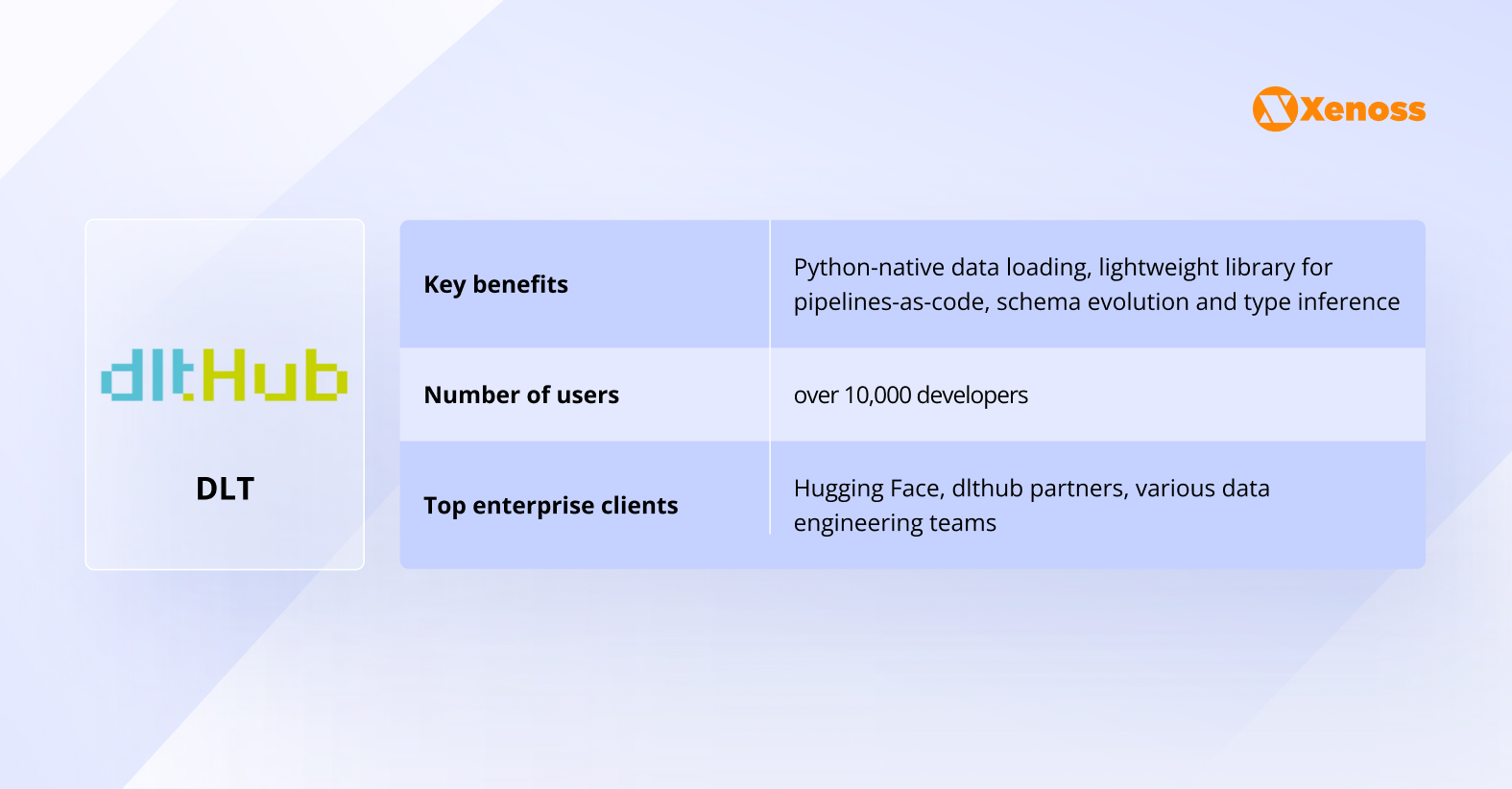
DLT is an open-source data loading framework that lets teams build ingestion pipelines directly in Python, treating data integration as code rather than a black-box platform.
It’s well-suited for engineering teams that are looking for lightweight, transparent ingestion with full control over logic and deployment without adopting a full-featured ETL platform.
Why data engineering teams choose DLT
DLT is particularly effective for teams that want full transparency and control over data ingestion without the overhead of running a dedicated integration platform.
Because pipelines are written in plain Python, engineers get to reuse existing code, apply custom logic at ingestion time, and version pipelines alongside application code.
This makes DLT a strong fit for lean teams that need to integrate APIs, files, or internal services quickly, prefer predictable infrastructure costs, and value debuggability and ownership over out-of-the-box automation.
Interestingly, dlt is the one that is natively programmatic (pip installable library) and code-based, which makes it the most friendly for LLMs as they are great for code generation. Plus the fact that itis highly flexible, so you can easily cover everything.
Reddit comment explaining why engineers prefer DLT for its flexibility
Challenges teams face with DLT
DLT places most of the responsibility for reliability and scale on the team, adding more burden on engineers as pipelines grow beyond a handful of sources.
There’s no native UI for monitoring data freshness, diagnosing failures, or managing dependencies, so teams have to build or integrate their own observability, alerting, and orchestration layers.
Because connectors are implemented as code rather than maintained services, handling API rate limits, authentication changes, backfills, and schema drift requires ongoing engineering work.
This maintenance overhead makes DLT difficult to sustain for organizations running dozens of integrations or requiring strong operational guarantees.
DLT pricing model
DLT is open-source and free to use, with no licensing or subscription fees. Teams pay only for the infrastructure they deploy it on (compute, storage, and networking) and any auxiliary services they integrate for orchestration, monitoring, or logging.
Total deployment costs will therefore vary based on workload scale and the operational tooling required to support production-grade pipelines.
4. dbt
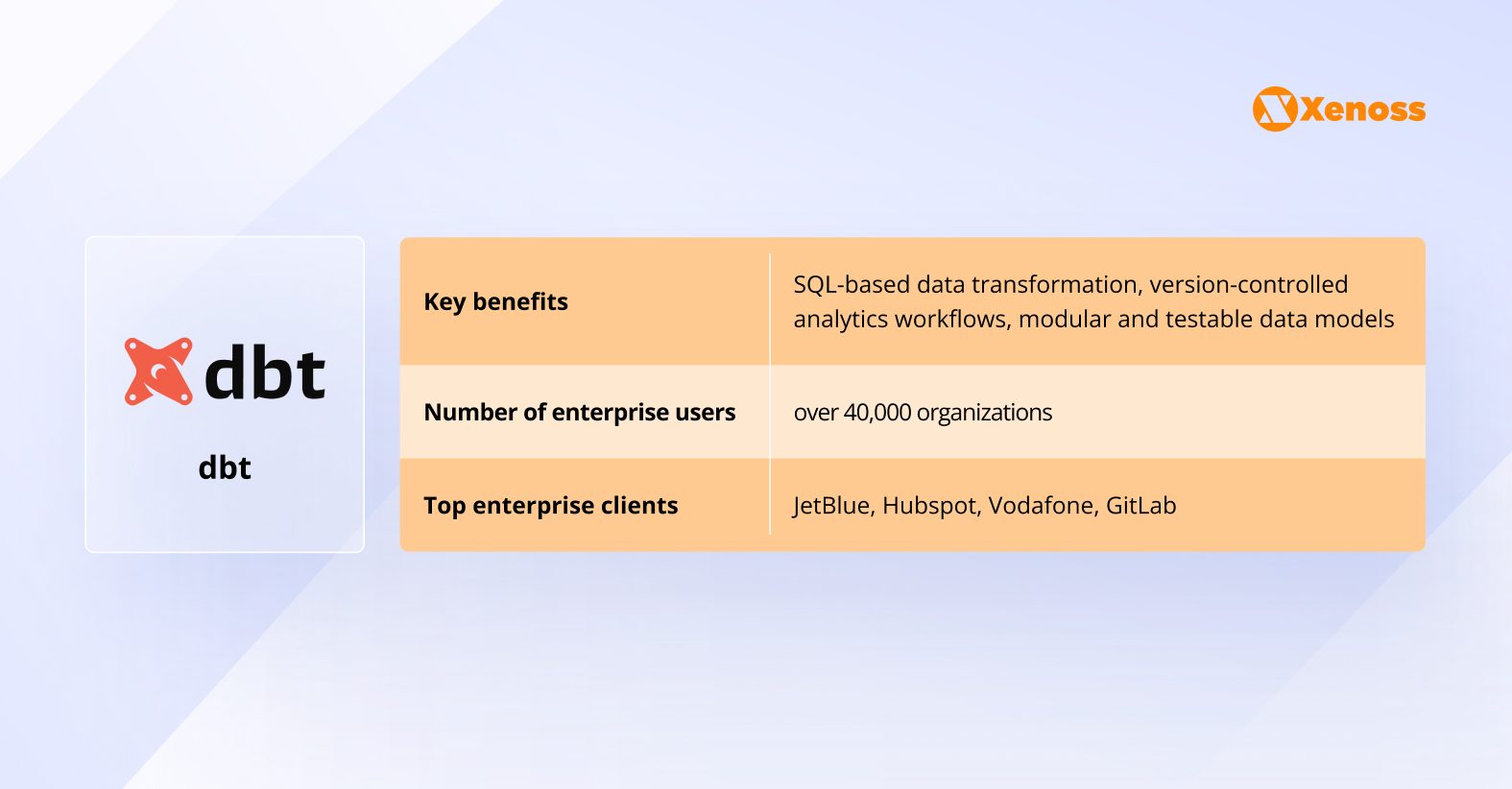
dbt plays a complementary role in data integration, focusing on transforming and modeling data after it’s been ingested into a warehouse or lakehouse.
While it doesn’t move data itself, dbt enables teams to standardize and test document data to turn raw inputs from multiple sources into analytics-ready datasets.
Why data engineering teams use dbt in data integration workflows
dbt brings structure and reliability to data integration workflows by making transformations explicit, version-controlled, and testable once data lands in the warehouse.
Treating transformations as code lets teams apply software engineering best practices, like code reviews, CI, and documentation, to keep integrated data consistent as sources evolve.
This approach reduces downstream data quality issues, improves trust in shared metrics, and allows ingestion tools to focus on moving data while dbt handles the business logic that turns it into usable datasets.
For transforms and infra, our engs always put dbt first, then airflow dagster or prefect to run things, and great expectations monte carlo or faddom for dq and lineage.
An engineer explains how dbt fits into the data integration flow
Challenges teams face with dbt
dbt often exposes gaps in data integration rather than solving them.
If upstream pipelines are late, inconsistent, or failing, dbt models will break or produce incomplete outputs.
As projects scale, teams commonly struggle with slow runs caused by long dependency chains, repeated full refreshes, and inefficient model design that increases warehouse compute costs.
Dbt pricing considerations
dbt’s open-source core framework is free to use. The managed offering, dbt Cloud, is priced based on developer seats and usage metrics like successful model runs and queried metrics.
Paid plans start at $100 per developer per month, with overage charges of around $0.01 per additional model run beyond included quotas.
| Developer (Free) | Seat-based, usage caps | Free, 1 developer seat, up to 3,000 successful models/month; jobs pause beyond limit | Individual analysts or evaluation projects. |
| Team / Starter | Seat-based + usage | $100 per developer/month, up to 5 developers, 15,000 models built, 5,000 queried metrics; extra models ~$0.01 each | Small to mid-sized data teams need collaboration features. |
| Enterprise | Custom pricing | Custom quoted; larger quotas (e.g., ~100,000 models, larger metric limits) and advanced features like API, governance | Large, cross-functional analytics organizations. |
| Enterprise+ / Premium | Custom pricing | Fully tailored SLAs, advanced security controls (e.g., PrivateLink, SSO, IP restriction), multiple environments | Regulated or global enterprises with stringent compliance needs. |
5. Informatica
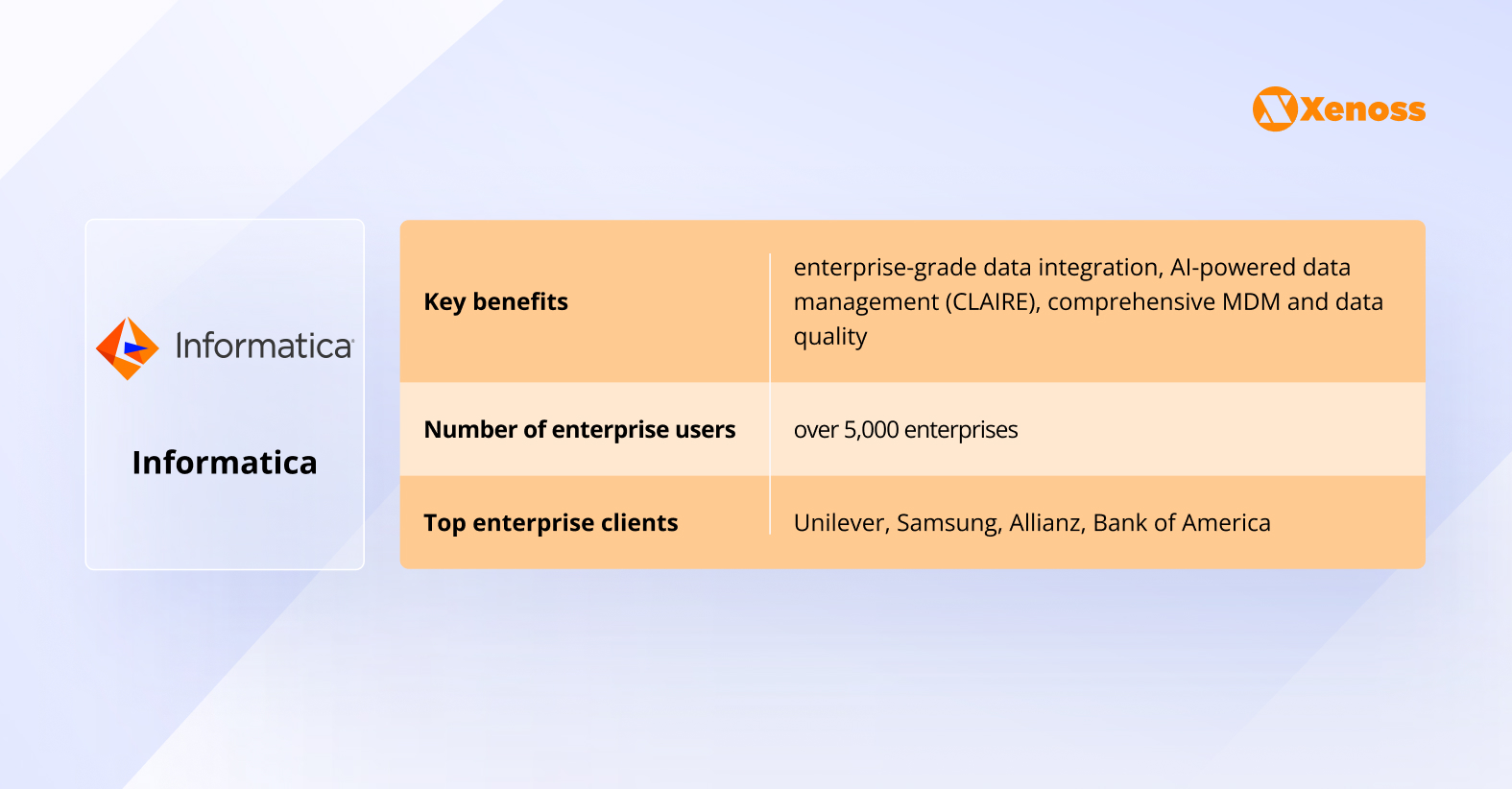
Informatica is an enterprise-grade data integration and management platform built for complex, large-scale environments spanning cloud, on-premises, and hybrid systems.
Why data engineering teams choose Informatica
Informatica is most valuable in organizations where data integration goes beyond moving data and requires enforcing standards across hundreds of pipelines and teams.
The platform provides deep, centralized controls for data quality rules, lineage, impact analysis, and access policies, allowing enterprises to understand how a metric was produced, what systems it touches, and what will break if a schema changes.
These strict controls prevent downstream incidents, enable smoother audits, and enable the ability to scale data operations across business units, reinventing integration logic or governance.
Still huge for large enterprise. Remember, the bigger you are the more things like privacy, compliance, security, SLAs etc. matter. Tools that can run unmanaged code, e.g., Spark, take extra scrutiny – especially for things like data exfiltration. Honestly, it’s a solid product but it’s completely lost its value prop due to a high price tag and because DE is becoming more commoditized.
In a Reddit comment, a data engineer points out that Informatica is still the go-to for enterprise but no longer has competitive pricing
Challenges teams face with Informatica
Informatica is challenging due to its complexity, cost, and operational overhead.
For smaller or fast-moving teams, the licensing model and heavyweight governance features may feel disproportionate to their needs, leading to underutilization or parallel “shadow” integration tools emerging outside the central system.
Informatica pricing considerations
Informatica’s cloud platform (Intelligent Data Management Cloud, or IDMC) uses a consumption-based pricing model built around Informatica Processing Units (IPUs).
This structure gives customers access to a broad set of integrated cloud services without paying for each component separately, with consumption tracked across metrics like data volume and processing activity.
The platform does not share pricing information publicly – it is typically negotiated based on usage patterns, enterprise size, and required services.
Which data integration platform to choose?
| - Fully managed ingestion with minimal maintenance - Automatic schema handling - Large, production-ready connector library - Very fast time to value. | - Limited customization and control - Often requires pairing with dbt or orchestration tools - Usage-based pricing becomes expensive at scale, especially with many connectors. | - From $0 (free tier) to $500–$1,067 per million MAR per connector, plus minimums - Costs reach tens to hundreds of thousands per year at scale. | Analytics-driven teams that want pipelines to “just work,” prioritize speed and reliability, and have limited data engineering capacity. | |
| - High flexibility and extensibility - Strong fit for custom, internal, or fast-changing data sources - Predictable costs at high volumes - Avoids vendor lock-in. | - Higher operational burden - Variable connector quality - Requires engineering ownership for reliability, scaling, and monitoring - Weaker SLAs unless on enterprise plans. | - $0 license (self-hosted) and infra costs - Cloud starts around $10/month, scaling to custom capacity-based enterprise contracts. | Engineering-led teams with DevOps maturity that need control, custom connectors, or high-volume ingestion without per-row pricing penalties. | |
| - Lightweight, Python-native ingestion - Full transparency and debuggability - Easy to version and integrate with CI/CD - Highly flexible for APIs and internal services. | - No managed UI or monitoring; reliability, retries, backfills, and schema drift handled manually - Does not scale easily to dozens of always-on pipelines. | $0 license. Costs limited to compute, storage, orchestration, and observability tooling (typically low to moderate, depending on scale). | Lean data teams that prefer code-first workflows need custom ingestion logic and tolerate hands-on operational management. | |
| - Strong transformation, testing, and documentation layer - Enforces analytics engineering best practices - Improves trust and consistency of integrated data. | - Not an ingestion tool - Dependent on upstream reliability - Scaling increases warehouse compute costs - Requires orchestration alongside other tools. | $0 (open source) or ~$100 per developer/month for dbt Cloud, plus usage overages and warehouse compute costs. | Teams that already ingest data and need to standardize, test, and govern transformations across many sources in the warehouse. | |
| -Deep enterprise-grade governance, lineage, data quality, and compliance - Strong support for hybrid and regulated environments - Centralized control at scale. | - High cost and complexity - Long implementation cycles - Requires specialized expertise - Often overkill for smaller or fast-moving teams. | - Typically, five- to six-figure annual contracts - IPU-based consumption model with custom negotiation. | Large enterprises with strict compliance, security, and governance requirements spanning many teams, systems, and regions. |
Building your own data integration platform
Off-the-shelf integration platforms help effectively manage common SaaS sources, standard schemas, and predictable volumes.
The real challenges emerge where data gets most valuable: high-change operational tables, proprietary internal systems, and cross-domain workflows requiring strict controls.
At this level, teams run into three recurring business constraints.
- Cost unpredictability. Usage pricing (for example, per-connector consumption models) turns incremental growth into surprise spend because every upstream change (updates or deletes, re-syncs, new connectors after an acquisition) increases billable activity.
- Time to change: When a connector breaks due to an API change or schema drift, organizations pay twice, once in platform fees and again in engineering hours. Handling data issues ends up taking engineer time from higher-value work like analytics enablement and AI productization.
- Governance fit. If teams can’t enforce quality checks, lineage, and privacy rules at the integration layer, bad data risks propagating into downstream decisions and reporting.
When these constraints dominate, building a custom integration layer is the more rational choice.
Tailored tools let data engineers optimize pipelines around unit economics, bake compliance and audit requirements into workflows by default, and move faster during M&A or product pivots, while keeping cloud spend predictable.
| Slower upfront due to design and engineering effort. | Fast: pipelines can be live in days or weeks. | |
| Infrastructure-based; costs scale with compute and storage. | Usage-based; costs scale with data volume, changes, and connectors. | |
| High once workloads stabilize and are budgeted. | Lower; spend can spike with growth, re-syncs, or schema changes. | |
| Full control over logic, latency, and architecture. | Limited to platform abstractions and vendor roadmap. | |
| High; requires in-house ownership of reliability and monitoring. | Low; vendor manages infra, scaling, and most failures. | |
| Precisely tailored to internal and regulatory requirements. | Strong for standard cases, rigid for bespoke needs. | |
| Minimal; architecture and IP remain internal. | Moderate to high; switching costs increase over time. | |
| Data integration is strategic to margin, risk, or differentiation. | Data integration is a supporting function, speed > control. | |
Bottom line
There’s no universal answer to choosing a data integration platform. Managed platforms minimize operational burden but limit customization. Open-source tools offer flexibility but require more engineering effort, and custom systems provide deep governance but add operational overhead.
The right choice depends on your team’s capabilities, data volumes, compliance requirements, and tolerance for operational overhead.
Start by identifying where your current approach is failing, whether that’s reliability, cost, flexibility, or governance, and evaluate platforms against those pain points rather than feature lists alone.